
Home -> Law Blog Directory -> Intellectual Property Law Blogs -> Electronic Freedom Foundation - Deep Links
(866) 635-2689 for Personal Injury or (866) 635-9402 for Criminal Defense
Find a Local Lawyer
Divorce (866) 635-6190
Personal Injury (866) 635-2689
Criminal Defense (866) 635-9402

Intellectual Property Law
: Electronic Freedom Foundation - Deep LinksDisability Access Activists Gather to Protest Kindle DRM
By tim

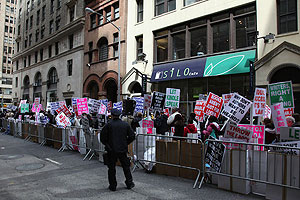 Yesterday, hundreds of people gathered in front of the headquarters of The Authors Guild in New York City to protest the removal of text-to-speech capabilities in Amazon's new Kindle 2 ebook device.
You may remember a few months ago, when The Authors Guild claimed (falsely) that the text-to-speech feature violated copyright law, and forced Amazon to disable it.
Now, the people who would have benefited most from the new feature — the blind, and others with reading disabilities — have made it clear that they're not going to stand for it.
Gizmodo's John Mahoney was there and has excellent coverage. He writes:
Everything was of course peaceful and contained right in front of the Authors Guild's seventh floor offices on 32nd street on Manhattan's east side. They had a pretty fantastic march ring set up, with many folks leading those who could not see at all in the ring, and sighted people whose job was to tell the marchers when to turn. Several seeing eye dogs joined in expressing their distaste.
Manon Ress of Knowledge Ecology International also attended and blogged the protest:
It is not that easy for 300 plus people (even with super smart dogs) and kids in tow to walk in a long circle for two hours holding big signs... These people were tough. It was an honor to walk with them.
In a statement, The Authors Guild called the protest "unfortunate and unnecessary," and declared, "We will not surrender our members' economic rights to Amazon or anyone else." They offered a novel solution to the problem: Amazon could maintain a registry of verified blind and disabled people, who would be granted special permission to use the text-to-speech feature.
The suggestion is of course ridiculous. Contrary to The Authors Guild's claims, the text-to-speech feature does not violate copyright law and does not pose any competitive threat to writers. The feature should be enabled for all Kindle customers, not just those with disabilities. The Authors Guild rightly laments "how difficult the road ahead is for the already fragile economics of authorship" — but this is exactly why it was nonsensical of them to force Amazon to adopt a system that has made it more difficult for blind and disabled customers to legally purchase and read authors' works.
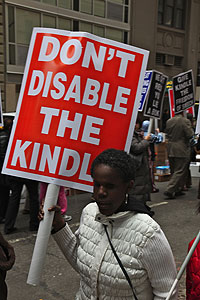 If you couldn't make the protest, but would like to support The Right To Read campaign, consider signing their petition to The Authors Guild. Many signers included a short personal story with their signature, and KEI's James Love has posted dozens of the most striking stories on Huffington Post. Here are a few that caught my eye:
Ann Marie Deverson, Florida: My daughter is visually impaired and she should be able to have access to the same literature everyone else does. I would think most authors would like to attract a wider audience. Braille books aren't always available, so why should my daughter and everyone else in the world who is blind or visually impaired be restricted access.
Martha Thorp, Kansas: Back in the day, books on tape saved me when I was unable to physically read and/or hold a hard-copy publication. In this time of highly refined technology, the act of preventing access to information is unthinkable.
Glenn Crosby, Louisiana: Access to printed material is critical to blind and other print disabled people if we are to compete effectively with our sighted counterparts, and as someone who reads "talking books" regularly, I would love to have access to a broader variety of materials. Not only that, I feel that since I am willing to pay for books, I should be able to access them just as others do.
The protest over the Kindle is just one area where disability rights are intersecting the fight over IP law. Globally, groups like the World Blind Union, EFF and KEI are working to ensure that copyright's exceptions and limitations really do provide the access to knowledge that lawmakers intended, and are not impeded by inconsistencies or overreaching anti-circumvention provisions.
Full post as published by Electronic Freedom Foundation - Deep Links on April 08, 2009 (boomark / email).
Worker's Compensation Laws Overview
Protect Workers From Injuries with plans that cover medical expenses and long-term or permanent disabilites
Disability Access
Developers pay $175,000 settlement for failing to comply with the Fair Housing Act.
LINA - Cigna Life Insurance Company of North America Disability Claims
LINA Insurance alleging violations of disability insurance claims.
Amazon Kindle
Class Action Filed over Cracking Defect
Getty Images
Faces Class Action over Premium Access
Microsoft Corp.
allegedly failed to provide adequate access and service to Xbox Live and its subscribers.
Discrimination
race, gender, disability, religious or age discrimiation.

#1 Online Legal Resource

On 08-25 at 15:46PM
Acute perpendicular parking #NYPD #NYFD
On 08-18 at 22:18PM
Parallel parking gone bad. Too much gas UES NYC
On 08-18 at 21:41PM
UES NYC
On 08-18 at 21:25PM
Twitter suspends journalist critical of broadcast partner's coverage on dubious grounds @guyadams #nbcfail #twitterfail
On 07-30 at 17:57PM
Model example of 1st Amendment suppression by the People of New York City's Michael Bloomberg #OWS #NYPD
On 07-12 at 21:07PM
AG Holder lackadaisical on Operation in our Sites domain name seizures & RIAA lobbied free speech suppression @dajaz1
On 06-08 at 22:44PM
Why is the Catholic Church going to court over Obama contraception policy? @NewYorker commentary
On 05-31 at 10:08AM
Monks sue Louisiana for right to sell caskets made from forrest destroyed by Katrina
On 05-31 at 07:47AM
Are the abortion ultrasound laws headed for the Supreme Court?
On 05-15 at 21:52PM





Are there some Disability Attorneys who do not gather RFC forms
Bipolar Disorder, Disability Benefits, Going Back to work and Disability Activists
10 reasons to buy a Kindle 2 and 10 reasons not to
Of all of the books to get on Kindle . . . .
Crime & Federalism Updates Via Kindle





 |
|
Contact Us | About Us | Celebrity Law Blog |
Our Partners | Disclaimer
| Law Blog Directory
| Law Jobs
| Law Tweets
| Oil Spill Video
All original material © 1999-2011 by USLaw.com. All other material, including Blog Directory feed content, are © by their respective copyright holders. |