
Home -> Law Blog Directory -> Law School Blogs -> MoneyLaw
(866) 635-2689 for Personal Injury or (866) 635-9402 for Criminal Defense
Find a Local Lawyer
Divorce (866) 635-6190
Personal Injury (866) 635-2689
Criminal Defense (866) 635-9402

Law School
: MoneyLawHow Top-Ranked Law Schools Got That Way, Pt. 2
By Jim Chen et al.
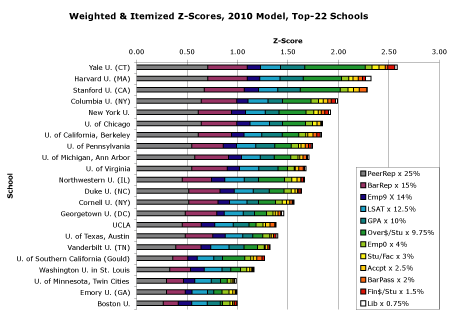
The above graph, "Weighted & Itemized Z-Scores, 2010 Model, Top-22 Schools," offers a snapshot comparison of how a wide swath of the top schools performed in the most recent USN&WR rankings. It reveals that the same effects we observed earlier, among just the top-12 schools, reach at least another ten schools down in the rankings. With the exception of Emory and Georgetown, Emp9 scores (indicated by the dark blue band) barely change from one top-22 school to another. Over$/Stu scores, in contrast (indicated by the middle green hue), vary widely; compare Yale's extraordinary performance on that measure with, for instance, Boston University's.
This graph also reveals some other interesting effects. Like the Emp9 measure, the Emp0 measure (for "Employment at Graduation," indicated in yellow-green) varies little from school to school. Indeed, it varies even less than the Emp9 measure does. Why so? Because all of these top schools reported such high employment rates. All but Minnesota reported Emp0 rates above 90%, and all but Georgetown, USC, and Washington U. reported rates above 95%.
These top 22 schools also reported very similar LSATs. Their weighted z-scores for that measure, indicated here in light blue, range from only.20 to .15. The weighed z-scores for GPA, in contrast, marked in dark green, range from .24 to .06.
As the graph indicates, the measures worth 3% or less of a school's overall score?student/faculty ratio, acceptance rate, Bar exam pass rate, financial aid expenditures/student, and library volumes and equivalents?in general make very little difference in the ranking of these schools. An exception to that rule sometimes appears in the BarPass scores (in dark orange) of the California schools, which benefit from a quirk in the way that USN&WR measures Bar Pass rates.
To best understand how a few law schools made it to the top of USN&WR's rankings, we should contrast their performances with those of the many schools that did not do as well. I'll thus sample the statistics of the law schools that ranked 41-51 in the most recent USN&WR rankings, those that ranked 94-100, and the eight schools that filled out the bottom of the rankings.
[Crossposted at Agoraphilia, MoneyLaw.]

Full post as published by MoneyLaw on August 23, 2009 (boomark / email).
KeyBank USA
alleging the bank offered loans for fraudulent vocational schools.
Kamehameha Schools
$7 million non-native Hawaiian racial discrimination settlement.

#1 Online Legal Resource

On 08-25 at 15:46PM
Acute perpendicular parking #NYPD #NYFD
On 08-18 at 22:18PM
Parallel parking gone bad. Too much gas UES NYC
On 08-18 at 21:41PM
UES NYC
On 08-18 at 21:25PM
Twitter suspends journalist critical of broadcast partner's coverage on dubious grounds @guyadams #nbcfail #twitterfail
On 07-30 at 17:57PM
Model example of 1st Amendment suppression by the People of New York City's Michael Bloomberg #OWS #NYPD
On 07-12 at 21:07PM
AG Holder lackadaisical on Operation in our Sites domain name seizures & RIAA lobbied free speech suppression @dajaz1
On 06-08 at 22:44PM
Why is the Catholic Church going to court over Obama contraception policy? @NewYorker commentary
On 05-31 at 10:08AM
Monks sue Louisiana for right to sell caskets made from forrest destroyed by Katrina
On 05-31 at 07:47AM
Are the abortion ultrasound laws headed for the Supreme Court?
On 05-15 at 21:52PM





Weekend Trivia Challenge - Top-Ranked Canadian Law School
SSRN Faculty Rankings (Law Schools Ranked 22-100 in U.S. News)
Feedback from Those Who Transferred to Higher-Ranked Law Schools:
Diversity Meets Law School GPA Data
Law Schools also Ranked by Blogs Now





 |
|
Contact Us | About Us | Celebrity Law Blog |
Our Partners | Disclaimer
| Law Blog Directory
| Law Jobs
| Law Tweets
| Oil Spill Video
All original material © 1999-2011 by USLaw.com. All other material, including Blog Directory feed content, are © by their respective copyright holders. |