Home -> Law Blog Directory -> Academic Blogs -> Essentially Contested America
(866) 635-2689 for Personal Injury or (866) 635-9402 for Criminal Defense
Find a Local Lawyer
Divorce (866) 635-6190
Personal Injury (866) 635-2689
Criminal Defense (866) 635-9402

Academic
: Essentially Contested AmericaTaking Aim: The Supreme Court Runs Out of Ammunition in Interpreting the Second Amendment
By Robert Justin Lipkin
"A well regulated Militia[,] being necessary to the security of a free State, the right of the people to keep and bear Arms shall not be infringed."
----- U.S. Constitution, Amendment II
Read Linda Greenhouse's piece in today's NY Times: "The Supreme Court on Thursday embraced the long-disputed view that the Second Amendment
protects an individual right to own a gun for personal use, ruling 5 to 4 that
there is a constitutional right to keep a loaded handgun at 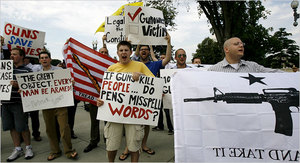 home for
self-defense. . . . The landmark ruling overturned the District of Columbia ban on handguns, the strictest
gun-control law in the country, and appeared certain to usher in a new round of
litigation over gun rights throughout the country. . . . The court rejected the view that the Second Amendment's 'right of the people to keep and bear arms' applied to gun
ownership only in connection with service in the 'well regulated militia' to
which the amendment refers. . . . Justice Antonin Scalia's majority opinion, his most important in his 22 years on the court,
said that the justices were 'aware of the problem of handgun violence in this
country' and 'take seriously' the arguments in favor of prohibiting handgun
ownership. . . . 'But the enshrinement of constitutional rights necessarily takes certain
policy choices off the table,' he said, adding, 'It is not the role of this
court to pronounce the Second Amendment extinct.' . . . Justice Scalia's opinion was signed by Chief Justice John G. Roberts Jr. and Justices Anthony M. Kennedy, Clarence Thomas and Samuel A. Alito, Jr." For the dissenting opinions continue reading here."
How Justice Scalia derives an individual right of self-defense from the Amendment's text is mysterious. Some scholars believe that he is justified in doing so because grammar and semantics require his conclusion. But in the logic of practical reasoning reasons and purposes limit the imperatives derived from them. I've written on this issue in ECA before and reprise an earlier post below.
_________________________________ECA, 17 February 2008
For the first time in over sixty years, the United States Supreme Court will soon decide one of the most polarizing constitutional controversies: What sort of regulations on guns does the 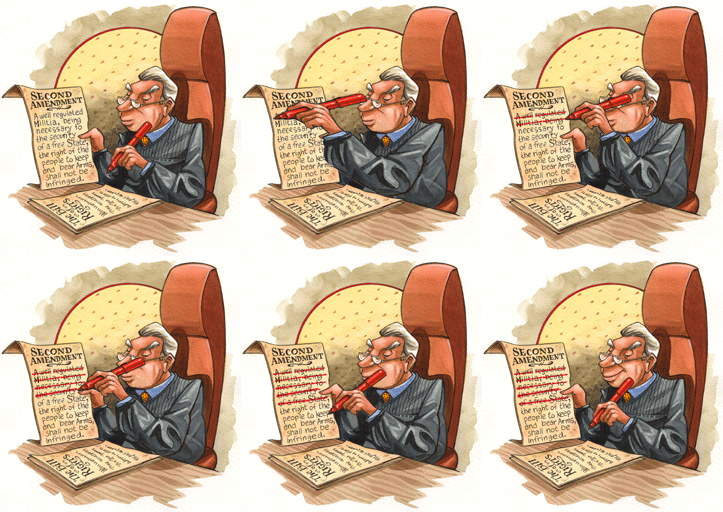 Second Amendment prohibit. The last time the Court decided a Second Amendment case was in 1939 in Miller v. United States where the Court held that a twelve inch sawed off shotgun was not protected under the Second Amendment. In the present case, District of Columbia v. Heller,
the Court will decide whether the District of Columbia's restrictive
gun regulations, regulations making it virtually impossible to use a
gun for self-defense even in one's home, violate the Second Amendment.
The implications of the Court's decision in this case are enormous
directly and indirectly affecting the constitutionality of gun control
legislation throughout the nation.[1]Although,
the Second Amendment implicates tough moral, cultural, and social
issues, the constitutional issue is this. While none of the rights
contained in the Bill of Rights is absolutely inviolable, some of them,
especially the right to free speech, require a strong judicial
presumption of constitutionality. For a regulation to succeed, the
government must have an unusually powerful justification. If the Court
uses the free speech clause of the First Amendment as the model for
applying the Second Amendment, gun control regulations will become
virtually taboo. Had the Second Amendment said, "The
right of the people to keep and bear arms shall not be infringed," gun
rights and speech rights would require the same type of justification.
But the Second Amendment includes a pesky, little preface, absent in
the First Amendment, qualifying the right in question. And that's where
the serious trouble begins.
In
deciding whether to uphold a lower court's decision striking down the
district's regulations, the Supreme Court must decide what effect, if
any, the clause--"A well regulated Militia[,] being necessary to the security of a free State"--has on the right contained in the clause "the right of the people to keep and bear Arms shall not be infringed"?[2]
In earlier decisions, the courts have viewed the preface to be the
reason the people have the right to keep and bear arms, namely, in
order to equip a well-regulated militia. How should the Court now
interpret the Second Amendment right in light of this qualifying
preface? The answer to this question is the core of this controversy.[3]
The vitriol surrounding this issue blinds proponents
of gun rights to the existence of the preface, while undue emphasis on
the preface tends to camouflage the right's existence. Constitutional
integrity requires the Second Amendment to be read in light of its
entire text. Focusing on one portion of text to the detriment of
another in effect rewrites the Amendment. The Roberts'
Court should be wary of handing down a decision that ignores any part
of the constitutional text. If it is not, the Court will be making law
from the bench usurping Congress' constitutional authority as lawmaker. Which
interpretation of the Second Amendment should the Court embrace? The
major contenders in this battle are two seemingly irreconcilable
interpretations. In one corner stands the state's right
interpretation and in the other corner stands the individual rights
interpretation. The former permits significant regulations of guns,
while the individual rights interpretation makes it much more difficult
to sustain such regulations. According to the state's rights interpretation, the Second Amendment guarantee was designed to prevent the fledgling federal government from daring even to think about disarming the state militias which was, at the State
constitutions during the founding era sometimes included prefaces which
qualified the various rights in question; however, none of the other
rights in the Bill of Rights do. The Founders must have had a reason
for including a preface in the Second Amendment, but not in the First
Amendment or any other provision in the Bill of Rights. Consequently,
it seems clear that the founders had no intention of making the right
to keep and bear arms a right of individuals; their goal was to protect
republican community, not liberal license. By contrast to this
historical explanation, the individual rights interpretation resonates
with contemporary sensibilities. In this view, the Second Amendment's
right is a right of individuals just like the right to freedom of
speech. Although the Second Amendment has a civic purpose expressed by
its preface, if Americans are to realize their birthright of liberty,
the right to own guns must be equally as significant as the right to
free speech. Both contribute to liberty which the Constitution was
designed to articulate and defend. Moreover, the only practical way to
ensure that the militia remains viable is for individuals to be armed. Interpreted in this fashion, the Roberts' Court should strike down the District's restrictive gun regulations. What
will the Court decide? Is the right in the Second Amendment a right of
states or an individual right of persons? Predicting what the Court
will do is a risky business, but a few things seem clear. The
Court will neither embrace a muscular state's rights position nor an
unqualified individual rights position. Indeed, there exists the
distinct possibility that the Court will split the time, the primary military
force used to defend the states. If the federal government could disarm
a state's militia, it could in effect banish the militia entirely. The reason states were intent on constitutionally protecting
their militias was simply their distrust of standing armies and the
conviction that an armed militia could prevent unconstitutional
domination by the federal government.[4] In
short, according to this position, the right to keep and bear arms is a
right of a state government to form and arm what in contemporary
America we know as the National Guard.[5] Since, according to this
interpretation, gun rights are inextricably linked to state militias, regulations
which do not affect a state's militia are beyond the Amendment's
scope. In fact, the most recent Supreme Court case, Miller v. United States
decided in 1939, made clear that only guns that were part of a
well-regulated militia are subject to Second Amendment protection. This
doomed sawed off shotguns which were the guns in question in the Miller case.
 difference between these competing interpretations. If so, the smart
money is on Justice Anthony Kennedy, typically the swing vote since
Justice O'Connor retired, to tip toe between these competing
interpretations leading the Court to fashion a compromise. The Second
Amendment contains a significant individual right, but not one not
requiring an unusually powerful reason for its regulation as is
required in the free speech cases. If the government's reason for
regulating gun rights is reasonable, that is, if it does not present an
undue burden on gun owners, then the regulation will be upheld. For
example, hunters and individuals keen on guns for self-defense can
count on Second Amendment protection. By contrast, licensing and
background checks, machine bans, gun-free zones, and other regulations
not posing an undue burden on gun owners would permissible. The
District's regulation making it virtually impossible to use a gun for
self-defense in one's home will be struck down. This compromise might
work for the moment, but neither side will be entirely satisfied. The
result is likely to be a firestorm of litigation over what counts as a
"reasonable" regulation, and when precisely does one place an "undue
burden" on gun rights. Judicial compromises rarely resolve hot-button
controversies. They just postpone debate until another day.
__________________________
[1]
The decision will apply directly to federal laws regulating guns, but
only indirectly applying to state laws. Before state laws can be
brought under the gambit of the Second Amendment, the Court must first
decide whether the Second Amendment is incorporated through the Due
process Clause of the Fourteenth Amendment to state laws.
[2]
Characterizing the issue in this manner sidesteps the question of
whether the right's clause in the Second Amendment is the same right as
the one in "The right to keep and bear arms . . ." One could argue that
the preface does not merely qualify the right but renders it dependent
on the preface for its content,
that is, for its scope and limits. Of course, this argument depends on
giving the comma less weight than most observers would claim it has.
[3] The Second Amendment is a paradigmatic case of a poorly drafted provision. Does it say anything more than "Because a well regulated militia is necessary to the security of a free state, the right of the people to keep and bear arms shall not be infringed." This seems to tie the right more closely to its justification. It also brings out more clearly the anachronistic element in the Amendment.
[4] The
idea that an armed citizenry could prevent a tyrannical United States'
government from getting away with oppression or even sufficiently
harassing the United States government into submission or even if slow
down oppressive practices to a significant degree is implausible in the
extreme. If that's so, and since the Framers believed a militia was a
better form of self-defense than a standing army, the question arises
whether the Amendment is still relevant to our changed circumstances.
[5] It
remains controversial whether the Second Amendment's militia language
can be reasonably regarded as referring to the National Guard or
whether it refers to some larger subset of the people.
Credit for First Image
Credit For Second Image
Credit For Third Image
Credit For Fourth Image
Full post as published by Essentially Contested America on June 27, 2008 (boomark / email).
Selection of State Supreme Court Judges
How State Court Judges are Selected
California Supreme Court Proposition 8 Decision
Court Rejects Challenges to Proposition 8, but Finds Marriages Valid
Is Barack Obama a Natural Born Citizen?
Wrotnowski v. Bysiewicz (Supreme Court): Does Obama meet the constitutional requirements to be President
Unwed Fathers' Rights in Adoption
Landmark Cases in Adoption Law Shape Law with respect to Unwed Fathers
Law Enforcement and Criminal Justice Career Choices
Descriptions of law enforcement occupations
Parody is a Protected Form of Speech
Targets of criticism seek to shut down Internet sites that poke fun
Ebay Fined
French Court Sets Fine at $61 Million
Personal Injury
Appeals Court Upholds Congressional Legislation
Tomato Salmonella
Sheetz Convenience Stores agrees to confidential out-of-court settlement with food poisoning victim.
National Association of Realtors
Settlement reached in broker listing antitrust lawsuit, pending court approval.
Missouri Attorney General's Office
$26,000 settlement reached in disability discrimination lawsuit, pending court approval.
Rutland School District
Double pay offered as part of class action wage dispute settlement, pending court approval.

#1 Online Legal Resource

On 08-25 at 15:46PM
Acute perpendicular parking #NYPD #NYFD
On 08-18 at 22:18PM
Parallel parking gone bad. Too much gas UES NYC
On 08-18 at 21:41PM
UES NYC
On 08-18 at 21:25PM
Twitter suspends journalist critical of broadcast partner's coverage on dubious grounds @guyadams #nbcfail #twitterfail
On 07-30 at 17:57PM
Model example of 1st Amendment suppression by the People of New York City's Michael Bloomberg #OWS #NYPD
On 07-12 at 21:07PM
AG Holder lackadaisical on Operation in our Sites domain name seizures & RIAA lobbied free speech suppression @dajaz1
On 06-08 at 22:44PM
Why is the Catholic Church going to court over Obama contraception policy? @NewYorker commentary
On 05-31 at 10:08AM
Monks sue Louisiana for right to sell caskets made from forrest destroyed by Katrina
On 05-31 at 07:47AM
Are the abortion ultrasound laws headed for the Supreme Court?
On 05-15 at 21:52PM







"Interpreting the Supreme Court's Medical Device Decision"
US SUPREME COURT HEARS SECOND AMENDMENT CASE
Will Some Felons Be Permitted To Own Guns After Heller
Governments failure to establish element of offense results in reversal.





 |
|
Contact Us | About Us | Celebrity Law Blog |
Our Partners | Disclaimer
| Law Blog Directory
| Law Jobs
| Law Tweets
| Oil Spill Video
All original material © 1999-2011 by USLaw.com. All other material, including Blog Directory feed content, are © by their respective copyright holders. |