Home -> Law Blog Directory -> International Law Blogs -> The Court
(866) 635-2689 for Personal Injury or (866) 635-9402 for Criminal Defense
Find a Local Lawyer
Divorce (866) 635-6190
Personal Injury (866) 635-2689
Criminal Defense (866) 635-9402

International Law
: The CourtPutting a Price On Lost Time: Ontario Pays William Mullins-Johnson $4.25 million settlement. Is it enough?
By Allison MacIsaac

The Ontario government recently agreed to pay William Mullins-Johnson, a victim of wrongful conviction, a $4.25 million reward to compensate him for 12 years spent in prison. Stories like this tend to raise the question in our minds of ?How does one put a price on lost time?? I will cover Mr. Mullins-Johnson?s acquittal at the Ontario Court of Appeal in 2007 and will take readers on a historical journey to determine what price governments have put on lost time to see if any patterns emerge. But I warn readers: I will not, and cannot answer the crucial question of how we price lost time.
PART ONE: R. v. Mullins-Johnson, 2007
Quite humbly and remorsefully, the Court of Appeal acquitted Mr. Mullins- Johnson in R. v. Mullins-Johnson, 2007 ONCA 720. The appeal arose from a Reference the Minister of Justice ordered on July 6, 2007. The Reference was directed to the Court pursuant to s. 696.3(3)(a)(ii) of the Criminal Code, asking the Court to determine the case as if it were an appeal on the issue of fresh evidence. On this ?appeal? two main issues were considered:
- What reasons existed to support the admission of fresh evidence?
- Should the Court go further and (in addition to an acquittal) declare Mr. Mullins-Johnson factually innocent?
(1) The Fresh Evidence
Four year old Valin Johnson was found dead in her bed one morning in 1993. Doctors at both the Sault. Ste. Marie General Hospital and the Hospital for Sick Children in Toronto assessed the situation. The initial findings by three doctors (one of whom is the now discredited Dr. Charles Smith) determined that the girl had suffered sexual abuse and died of homicidal asphyxiation. Since Mr. Mullins-Johnson had been babysitting at the estimated time of death, he was quickly arrested and charged with first degree murder and aggravated sexual assault.
However, the Association in Defence of the Wrongfully Convicted (AIDWYC) enlisted the help of an eminent pathologist, Professor Bernard Knight to contest this charge. Professor Knight requested information from Dr. Michael Pollanen, the Chief Forensic Pathologist for Ontario. Both doctors performed their own separate investigations, and discovered that the ?signs? of abuse and murder were simply the result of normal processes following death or, (in some cases) were caused by procedures connected to the post-mortem autopsy. The doctors later met to substantiate their separate investigations and both concluded the initial evidence was incorrect.
O?Connor, A.C.J.O, writing for an unanimous court, determined that the evidence clearly met the test for admitting new evidence established in R. v. Palmer, [1980] 1 S.C.R. 759. Further, he stated if the evidence had not met the Palmer test, the result in R. v. Maciel (2007), 219 C.C.C. (3d) 516 (Ont. C.A.) would apply, where Doherty J.A. stated, ?Evidence should be received on appeal, regardless of whether it was available at trial?if the evidence is sufficiently cogent to warrant an acquittal.? Clearly in this situation, this evidence was extremely damaging to the prior conviction.
(2) The Issue of Factual Innocence
The Court then went on to consider the possibility of declaring Mr. Mullins-Johnson to be ?factually innocent.? While the law only requires a finding of ?not guilty? to support an acquittal, it was suggested that Mr. Mullins-Johnson be declared ?factually innocent? as well. The main difference between these two characterizations is that a finding of factual innocence requires absolutely no reasonable belief an accused could have committed a crime. The Court of Appeal declined to make this statement, concluding that there are not two types of acquittals available in Canada. Their decision to deny the request stemmed from policy considerations, primarily, that the meaning of a ?not guilty? verdict would be degraded to all others in the criminal system. A ?higher? statement of ?factual innocence? could cast doubt on the innocence of those receiving not guilty verdicts, thereby eroding the fundamental principle of criminal law: innocent until proven guilty.
PART TWO: Crunching The Numbers
To the best of my knowledge, no publication exists in which compensation on an annual basis has been calculated for Canada. To arrive at these figures, I simply divided the total amount awarded by the number of years the accused spent in jail. Below is a chart I have created through my own research. Some of the most high-profile wrongful convictions were sampled for the purposes of this table.
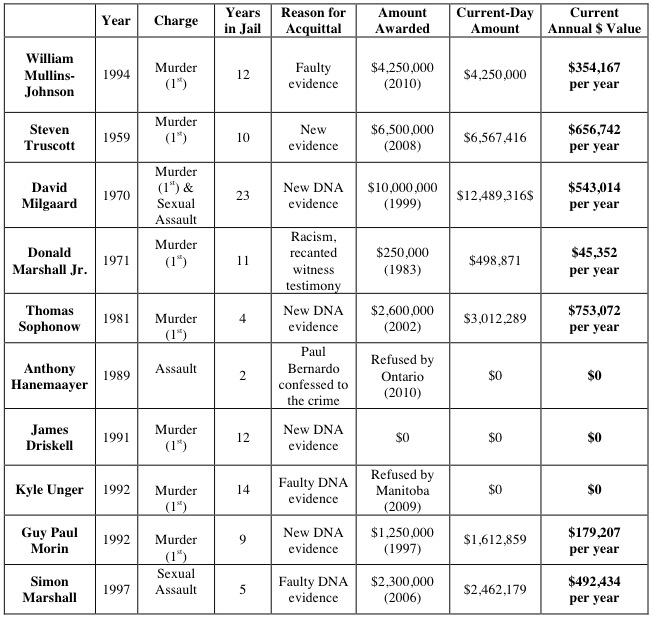
* Disclaimer: This chart is not statistically significant as a result of the low sample size. Readers are welcome to comment for further information on the data collection and calculations found in this chart.
Before compiling this chart, I was certain patterns would emerge. Although unsure as to exactly what I would find, I assumed there might be some correlation between the reason for acquittal, years spent in prison and perhaps the initial charge and the victim?s damage settlement amount.
Was I ever wrong! Readers will notice that the length of time does not seem to have an obvious pattern. Rather discouragingly, some victims of wrongful conviction were denied settlement in any way. Claimants are able to engage in litigation in an attempt to recover compensation, but, of course this is costly and timely. Of those awarded some sort of compensation, the annual amount is extremely spread out, from about $45,000 per year to $753,000 per year! The data also shows no correlation between current awards and past awards ? so no historical ?improvement? can be inferred.
The Future of Wrongful Convictions in Canada
In a nutshell, it appears as if those who are wrongfully convicted have no way of predicting the amount of potential damage settlements. The answer to our question of ?How much is one year is prison worth?? has no concrete answer. A huge range exists, and according to preliminary research, damage awards seem to be arbitrarily determined. Whatever the amount, though, I believe most would agree with me when I say there is no price you can put on one?s freedom. It is therefore in society?s best interest to address these deficiencies in the justice system and take all available steps to prevent these terrible miscarriages of justice.
Full post as published by The Court on November 01, 2010 (boomark / email).
Heart of Atlanta v United States
Supreme Court Decision: Civil Rights Act Protected by Interstate Commerce Clause
Bextra Injury Risks
Bextra Increases Risk of Fatal Heart Attack
Johnson & Johnson 401(k) / ERISA Stock Fraud
Johnson & Johnson 401(k) / ERISA Stock Fraud
Ontario Lottery and Gaming Corporation
has been accused of not doing enough to keep addicted gamblers who have signed up for a "self-exclusion" program out of casinos.
Investor Fraud
Company president and director Gregory William Rivers to pay $10,000 shareholder fraud settlement.
Amazon
Teen Sues over Lost Homework
British Airways Lost-Luggage
Class-Action Gets Green Light
Daimler Chrysler et al.
alleged negligence pertaining to lost confidential client data which exposed customers to identity theft

#1 Online Legal Resource

On 08-25 at 15:46PM
Acute perpendicular parking #NYPD #NYFD
On 08-18 at 22:18PM
Parallel parking gone bad. Too much gas UES NYC
On 08-18 at 21:41PM
UES NYC
On 08-18 at 21:25PM
Twitter suspends journalist critical of broadcast partner's coverage on dubious grounds @guyadams #nbcfail #twitterfail
On 07-30 at 17:57PM
Model example of 1st Amendment suppression by the People of New York City's Michael Bloomberg #OWS #NYPD
On 07-12 at 21:07PM
AG Holder lackadaisical on Operation in our Sites domain name seizures & RIAA lobbied free speech suppression @dajaz1
On 06-08 at 22:44PM
Why is the Catholic Church going to court over Obama contraception policy? @NewYorker commentary
On 05-31 at 10:08AM
Monks sue Louisiana for right to sell caskets made from forrest destroyed by Katrina
On 05-31 at 07:47AM
Are the abortion ultrasound laws headed for the Supreme Court?
On 05-15 at 21:52PM





Countrywide settlement pays fraction to investors
Amgen, Johnson & Johnson Come to Truce in Oncology Marketing Suit
NOW She Says "The Price" is Wrong That's Just B.S.
The Structured Settlement Illiterate Tip of The Day "featuring" Stan Johnson
J&J Pays $68.7 Million to Settle Hundreds of Orthro-Evra Cases





 |
|
Contact Us | About Us | Celebrity Law Blog |
Our Partners | Disclaimer
| Law Blog Directory
| Law Jobs
| Law Tweets
| Oil Spill Video
All original material © 1999-2011 by USLaw.com. All other material, including Blog Directory feed content, are © by their respective copyright holders. |