
Home -> Law Blog Directory -> Intellectual Property Law Blogs -> IPKat
(866) 635-2689 for Personal Injury or (866) 635-9402 for Criminal Defense
Find a Local Lawyer
Divorce (866) 635-6190
Personal Injury (866) 635-2689
Criminal Defense (866) 635-9402

Intellectual Property Law
: IPKatArchiving online citations: are we all Americans now?
By Johanna Gibson, David Pearce, Jeremy Phillips and Ilanah Simon.

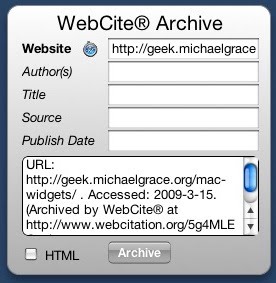 As an occasional academic himself, the IPKat takes great interest in the issue raised in the following request for information from his friend Susan Hall (Cobbetts), who writes to him as follows:
"As citing online sources in academic papers becomes more acceptable, one issue which is becoming more important is the fragile nature of online materials and the obvious concern when reviewing or answering papers which cite online sources, that such sources remain accessible for verification and follow-up. A tool called WebCite, offered here, purports to offer an answer, allowing people who cite online sources to cache them on the WebCite servers, on the terms set out on the site in question.However, this seems to produce a number of interesting IP implications on both sides of the Atlantic (incidentally, the examples of archiving of site uses are drawn from the Guardian).
The advertised service appears intended to protect people using online sources in academic research from dead links and future take-downs, but there seem difficulties fitting the WebCite model into a UK copyright framework. Further, although the WebCite FAQs put forward a justification based on fair use under US law, this is itself not devoid of problems:
"Caching and archiving webpages is widely done (e.g. by Google, Internet Archive etc.), and is not considered a copyright infringement, as long as the copyright owner has the ability to remove the archived material and to opt out. WebCite® honors robot exclusion standards, as well as no-cache and no-archive tags. Please contact us if you are the copyright owner of an archived webpage which you want to have removed".
A U.S. court has recently (Jan 19th, 2006) ruled that caching does not constitute a copyright violation, because of fair use and an implied license (Field vs Google, US District Court, District of Nevada, CV-S-04-0413-RCJ-LRL, see also news article on Government Technology). Implied license refers to the industry standards mentioned above: If the copyright holder does not use any no-archive tags and robot exclusion standards to prevent caching, WebCite® can (as Google does) assume that a license to archive has been granted. Fair use is even more obvious in the case of WebCite® than for Google, as Google uses a ?shotgun? approach, whereas WebCite® archives selectively only material that is relevant for scholarly work. Fair use is therefore justifiable based on the fair-use principles of purpose (caching constitutes transformative and socially valuable use for the purposes of archiving, in the case of WebCite® also specifically for academic research), the nature of the cached material (previously made available for free on the Internet, in the case of WebCite® also mainly scholarly material), amount and substantiality (in the case of WebCite® only cited webpages, rarely entire websites), and effect of the use on the potential market for or value of the copyrighted work (in the case of Google it was ruled that there is no economic effect, the same is true for WebCite®)." (FAQs)Asks Susan, "Is anyone doing any work on archiving of online sources and the legal issues entailed?" If so, she -- and, out of sheer curiosity, the IPKat -- would love to know.

Full post as published by IPKat on June 29, 2010 (boomark / email).
Online Ticket Vendor
Buying Tickets Online That Never Arrive
Google Sued for Violating the Privacy Rights of Millions of Americans
Google Sued for Violating the Privacy Rights of Millions of Americans
Kimkins
alleging false advertising of online dieting.
Online Medication Sites
Prescription Drugs Sold Without Prescriptions
Marketing Spam
Member Source Media pays $200,000 civil penalty for deceptive online advertising.
imbee Data Collection
Industrious Kid, Inc. pays $130,000 civil penalty for violating the Children’s Online Privacy Protection Act.

#1 Online Legal Resource

On 08-25 at 15:46PM
Acute perpendicular parking #NYPD #NYFD
On 08-18 at 22:18PM
Parallel parking gone bad. Too much gas UES NYC
On 08-18 at 21:41PM
UES NYC
On 08-18 at 21:25PM
Twitter suspends journalist critical of broadcast partner's coverage on dubious grounds @guyadams #nbcfail #twitterfail
On 07-30 at 17:57PM
Model example of 1st Amendment suppression by the People of New York City's Michael Bloomberg #OWS #NYPD
On 07-12 at 21:07PM
AG Holder lackadaisical on Operation in our Sites domain name seizures & RIAA lobbied free speech suppression @dajaz1
On 06-08 at 22:44PM
Why is the Catholic Church going to court over Obama contraception policy? @NewYorker commentary
On 05-31 at 10:08AM
Monks sue Louisiana for right to sell caskets made from forrest destroyed by Katrina
On 05-31 at 07:47AM
Are the abortion ultrasound laws headed for the Supreme Court?
On 05-15 at 21:52PM





E-discovery, archiving vendors team up at LegalTech
E-mail Archiving Demands Overwhelm Backup Alternative
OEDb's Online College Rankings 2008
Shawnee PD had 18 seatbelt, 1 DUI citations over Thanksgiving





 |
|
Contact Us | About Us | Celebrity Law Blog |
Our Partners | Disclaimer
| Law Blog Directory
| Law Jobs
| Law Tweets
| Oil Spill Video
All original material © 1999-2011 by USLaw.com. All other material, including Blog Directory feed content, are © by their respective copyright holders. |