
Home -> Law Blog Directory -> Politics Blogs -> Open Congress
(866) 635-2689 for Personal Injury or (866) 635-9402 for Criminal Defense
Find a Local Lawyer
Divorce (866) 635-6190
Personal Injury (866) 635-2689
Criminal Defense (866) 635-9402

Politics
: Open CongressPayday Loan Industry Uses Anti-Bank Sentiment to Fight Regulation
By Sunlight Foundation & Participatory Politics Foundation
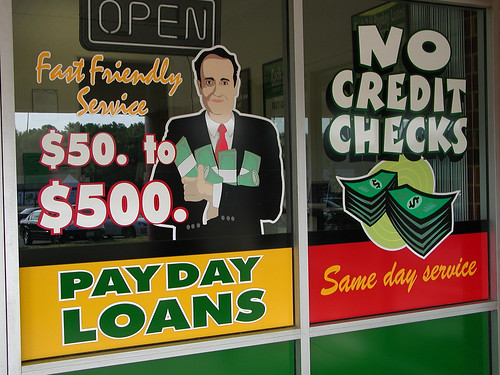
For being such a relatively small and unpopular industry, payday loan companies have had a good deal of success convincing members of Congress to go easy on them as they take up financial regulatory reform. Earlier this year, House Democrats proposed legislation that would have capped payday loan interest rates at an outrageous 390% for the average consumer. And a special carve-out in the consumer protections portion of the financial reform bill has been at the heart of negotiations over striking a bipartisan agreement on that portion of the bill.
Under the financial reform bill that the Senate is currently debating (the Restoring Financial Stability Act of 2010), payday lenders would be subject to new regulations promulgated by the proposed Consumer Financial Protection Bureau to ensure that their services are “fair, transparent, and competitive.” Depending on how aggressive the Bureau ends up being, the rules could severely limit the terms under which payday lends could do business.
But while the underlying bill isn’t good for the payday loan industry, an amendment being proposed to it from Sen. Kay Hagan [D, NC], and being co-sponsored by Sen. Dick Durbin [D, IL] and Sen. Charles Schumer [D, NY], could be more damaging. It would ban payday lenders from giving out new loans to customers who have already taken out six payday loans or have been under loan obligations for more than 90 days in the past year. According to consumer advocacy groups, the average payday loan borrowers takes out 9 loans per year.
As we have seen, the payday loan industry is surprisingly savvy in politics. Their campaign to fight the Hagan amendment is no exception. According to Congress Daily ($), instead of defending their own industry, they are using the smart and timely tactic of labeling the amendment as an attempt to benefit the big banks:
The industry claims that while Hagan’s amendment would reduce their business, it would not benefit their customers because they would have to rely on more expensive overdraft fees offered by commercial banks to cover expenses when they are strapped for cash.
“You have loan limitations when you have banks that can make four overdraft protections a day,” said Steven Schlein, spokesman for the Consumer Financial Services Association, which represents 150 providers. The association has spent $550,000 in lobbying this year and is slated to air a TV ad against the Hagan amendment in the D.C. market. “All this going to do is help banks get more in overdraft protection fees,” Schlein said.
Payday lenders note that they charge $15 for every $100 borrowed on a typical two-week payday loan, but that overdraft fees on a bounced check or overextended debit card can be much more, with an average of nearly $30, bringing in $43.8 billion to banks last year.
If payday lending were to be eliminated, banks and credit unions would stand to gain more than $13 billion if customers choose to opt-in for overdraft coverage, given the dearth of short-term lending options, according to Michael Flores of Bretton Woods Inc., an economic consulting firm.
“In a financial lifespan of a consumer, this fills a segment. This isn’t a lifelong financial consumer use versus a checking account,” said Flores, who has done consulting work for the industry. “Nothing good happens by bouncing a check.”
The industry also is privately hinting that Hagan is doing the bidding for banks that stand to profit from the change, especially Charlotte, N.C.-based Bank of America, where Hagan worked as executive for its predecessor NationsBank. “It’s no surprise Hagan introduced this bogus consumer protection bill, which manipulates national banking law to help megabank buddies reap billions in profits,” said one source.
Hagan aides laughed off the criticism and said the attacks show more desperation for an industry that cannot bear the scrutiny of its practices. Hagan has tangled with the industry before. As a state senator, she helped change state law making it unfeasible for payday lenders to operate in the Tar Heel State, one of 16 states where the industry has no presence because of tight regulations, such as interest rate caps.
“I am working on including an amendment in Wall Street reform that will prevent the payday lending industry from continuing to gouge people who are struggling to make ends meet. The industry is, of course, attempting to kill this commonsense amendment for consumers,” she said in a statement.
“The industry’s goal is to continue to prey on people who have suffered in this economy with loan upon loan at 400 percent interest. My goal is to ensure this predatory industry has reasonable limits so that American families no longer sink into a spiral of debt.”
It’s a smart tactic, but it doesn’t make much sense. First of all, most people using payday loan services don’t have bank accounts. Secondly, the Federal Reserve recently promulgated new rules requiring banks to give their customers a choice to opt-in to overdraft protection or not. If you haven’t received an opt-in letter from your bank yet, expect one soon. And thirdly, the financial reform bill contains a provision establishing a grant for a new Community Development Financial Institutions, which would be specifically designed under the bill to be “low-cost alternative to payday loans.”
You can see the Hagan amendment, which has also been introduced as a stand-alone bill, right here — S.3245 – Payday Lending Limitation Act of 2010.
Full post as published by Open Congress on May 04, 2010 (boomark / email).
Truth In Lending Act
Consumer Loans and Consumer Credit Protection Act
The Mortgage Forgiveness Debt Relief Act
Phantom Income Relief on Debt Cancellation
Whats a Home Loan Modification?
How to Qualify for a Home Loan Modification
Hurricane Ike
Gulf Coast Residents Fight for Compensation
Chevy Chase Bank
lawsuit claims the bank is in violation of the Truth in Lending Act
Bank Transaction
City Bank president Mike Liner agrees to pay $25,000 fine for assisting in a cash deposit.
NCAA Sued for Conspiracy and Anti-competitive Practices Related to Athletic Scholarships
NCAA Sued for Conspiracy and Anti-competitive Practices Related to Athletic Scholarships
Bank Scandal
Swiss bank pays Parmalat $30 million bankruptcy settlement.
Oil and Gas
industry workers allegedly subject to serious accident injury from hazardous conditions.

#1 Online Legal Resource

On 08-25 at 15:46PM
Acute perpendicular parking #NYPD #NYFD
On 08-18 at 22:18PM
Parallel parking gone bad. Too much gas UES NYC
On 08-18 at 21:41PM
UES NYC
On 08-18 at 21:25PM
Twitter suspends journalist critical of broadcast partner's coverage on dubious grounds @guyadams #nbcfail #twitterfail
On 07-30 at 17:57PM
Model example of 1st Amendment suppression by the People of New York City's Michael Bloomberg #OWS #NYPD
On 07-12 at 21:07PM
AG Holder lackadaisical on Operation in our Sites domain name seizures & RIAA lobbied free speech suppression @dajaz1
On 06-08 at 22:44PM
Why is the Catholic Church going to court over Obama contraception policy? @NewYorker commentary
On 05-31 at 10:08AM
Monks sue Louisiana for right to sell caskets made from forrest destroyed by Katrina
On 05-31 at 07:47AM
Are the abortion ultrasound laws headed for the Supreme Court?
On 05-15 at 21:52PM





Conflict of Laws- What Law does Apply to Internet Payday Loans
In trouble with an internet payday loan Change banks.
Attorney Sues Americash for PayDay Loan Hell
Payday lending interest rates forced down in Ohio
Payday lenders are corporate loan sharks





 |
|
Contact Us | About Us | Celebrity Law Blog |
Our Partners | Disclaimer
| Law Blog Directory
| Law Jobs
| Law Tweets
| Oil Spill Video
All original material © 1999-2011 by USLaw.com. All other material, including Blog Directory feed content, are © by their respective copyright holders. |