
Home -> Law Blog Directory -> Bailout Blogs -> Calculated Risk
(866) 635-2689 for Personal Injury or (866) 635-9402 for Criminal Defense
Find a Local Lawyer
Divorce (866) 635-6190
Personal Injury (866) 635-2689
Criminal Defense (866) 635-9402

Bailout
: Calculated RiskA few comments on Q1 GDP Report
By Anonymous
As I noted earlier, the two leading sectors, residential investment (RI) and personal consumption expenditures (PCE), were mixed. RI declined to a new record low as percent of GDP, however PCE increased at a 3.6% real annualized rate.
The increase in PCE does not seem sustainable unless employment and incomes increase soon. A large portion of the increase in PCE came from a decrease in personal saving.
 Click on graph for larger image in new window.
This graph shows personal saving as a percent of disposable personal income.
It is not unusual for the saving rate to decline at the beginning of a recovery as people become more confident. This helps drive consumer spending, but with the high levels of household debt, I expect the saving rate to increase over the rest of the year.
Here are some Q1 numbers (all annualized):
So the boost in PCE came from the decline in saving and the increase in benefits. That is not sustainable.
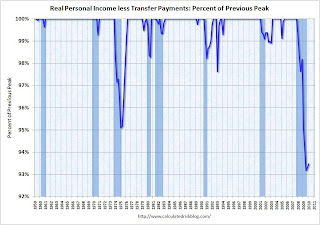 The second graph shows real personal income less transfer payments as a percent of the previous peak.
Unlike the recovery in GDP (previous post), real personal income less transfer payments has barely increased and is still 6.6% below the pre-recession level.
The peak of the stimulus spending is in Q2 2010 (right now), and then the stimulus spending starts to taper off in the 2nd half of 2010. So underlying demand better increase soon - and that means jobs and incomes going forward.
Unfortunately residential investment is usually one of the key engines for employment and growth at the beginning of a recovery - and I expect RI to be sluggish all year because of the huge overhang of existing housing units. So my guess is the recovery will probably remain sluggish, and I still expect a slowdown in the 2nd half of 2010.

Full post as published by Calculated Risk on April 30, 2010 (boomark / email).
Mitchell Report Summary
Report on Steroid Drug Use in Major League Baseball by Senator George Mitchell
Truth In Lending Act
Consumer Loans and Consumer Credit Protection Act
Bank Website Security
New Report Finds Widespread Flaws
Operating Room Fires
Hundreds Injured During Surgery, New Report Shows
Tree Stands
Ardisam Inc. pays $420,000 settlement for failing to report defective product to government officials.

#1 Online Legal Resource

On 08-25 at 15:46PM
Acute perpendicular parking #NYPD #NYFD
On 08-18 at 22:18PM
Parallel parking gone bad. Too much gas UES NYC
On 08-18 at 21:41PM
UES NYC
On 08-18 at 21:25PM
Twitter suspends journalist critical of broadcast partner's coverage on dubious grounds @guyadams #nbcfail #twitterfail
On 07-30 at 17:57PM
Model example of 1st Amendment suppression by the People of New York City's Michael Bloomberg #OWS #NYPD
On 07-12 at 21:07PM
AG Holder lackadaisical on Operation in our Sites domain name seizures & RIAA lobbied free speech suppression @dajaz1
On 06-08 at 22:44PM
Why is the Catholic Church going to court over Obama contraception policy? @NewYorker commentary
On 05-31 at 10:08AM
Monks sue Louisiana for right to sell caskets made from forrest destroyed by Katrina
On 05-31 at 07:47AM
Are the abortion ultrasound laws headed for the Supreme Court?
On 05-15 at 21:52PM





REPORT ON PROPOSED RULE 2.2 FROM THE ISBA 2007 ANNUAL MEETING
IP Justice Comments on ICANN Proposal to Expand Trademarks in Domain Names
ABA Section of Legal Education - Report of the Special Committee on Security of Position
Comments, comments! It's my birthday for cryin' out loud!
Teen reports mom for Facebook comments





 |
|
Contact Us | About Us | Celebrity Law Blog |
Our Partners | Disclaimer
| Law Blog Directory
| Law Jobs
| Law Tweets
| Oil Spill Video
All original material © 1999-2011 by USLaw.com. All other material, including Blog Directory feed content, are © by their respective copyright holders. |