Home -> Law Blog Directory -> Academic Blogs -> The Faculty Lounge
(866) 635-2689 for Personal Injury or (866) 635-9402 for Criminal Defense
Find a Local Lawyer
Divorce (866) 635-6190
Personal Injury (866) 635-2689
Criminal Defense (866) 635-9402

Academic
: The Faculty LoungeWhat (If Anything) Do We Owe Future Generations?
By Alfred Brophy
As I'm beginning to emerge from (or at least can see the possibility of emerging from) a semester of lots and lots of teaching and service, I'm starting to accumulate a list of things I want and need to read. There's a big stack of antebellum literary addresses, which I love. And then there's the recent scholarship I need to catch up on, like the symposium that the GW Law Review ran last fall on What Does Our Legal System Owe Future Generations. This is a mighty interesting topic--sort of the early twenty-first century version of "should trees have standing," which, btw, will be out in a third edition in the spring.
I haven't seen a lot of blogosphere discussion of this symposium, though that may just be because I've been hunkered down this semester. One way of approaching this, I think, is historically--did previous generations think (and act like) their legal system owed us something? Previous generations have done a heck of a lot for us, no doubt. And they did so in part, perhaps large part, because they were building something better for the future. One of my favorite quotes along these lines is Ralph Waldo Emerson's observation in "The American Scholar" that insects store up for future generations. He found the common elements of the human mind to store up knowledge "like the fact observed in insects, who lay up food before death for the young grub they shall never see." There's a great tradition in America--and in human society more generally, I suppose, though I don't have the expertise to testify to it--of making sacrifices for future generations, of doing something so that people whose names we will never know can have a better life. One thinks, of course, of the American Revolution here -- and of course the Puritans' Errand into the Wilderness.
Perhaps tragically, though unsurprisingly, there's also a very long lineage to the tradition of getting as much as one can at the present and letting future generations fend for themselves. In fact, I'd say that tradition has a much more robust lineage than the one of the sense that we owe duties to future generations.
And, returning to the idea that there are duties owed to future generations, whether those were seen as legally enforceable duties is a separate matter. Moreover, how those principles might have operated in legislatures and courts is something worth some mental elbow grease. I suppose one place to think about this in private law is in the law of trusts, where we are self-consciously looking to preserve something for future beneficiaries. But even there, the inquiry is defined by the settlor's intent. As I say, I'm looking forward to thinking through these papers in some detail as I take a break from plowing through stacks and stacks of exams.
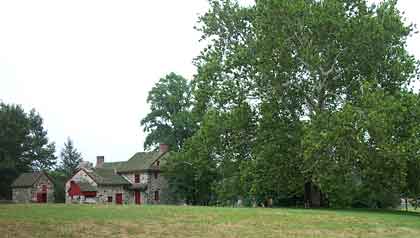
The image is of a Sycamore tree at the Brandywine Battlefield Park, next to the house where LaFayette stayed at the time of the battle. The tree was a lot smaller then, though apparently it was already at that point over 100 years old. How's that for an image for talk of the debts future generations incurred on our behalf? I'll get a nice picture of that when I'm home over winter break, I hope.
Full post as published by The Faculty Lounge on December 06, 2009 (boomark / email).

#1 Online Legal Resource

On 08-25 at 15:46PM
Acute perpendicular parking #NYPD #NYFD
On 08-18 at 22:18PM
Parallel parking gone bad. Too much gas UES NYC
On 08-18 at 21:41PM
UES NYC
On 08-18 at 21:25PM
Twitter suspends journalist critical of broadcast partner's coverage on dubious grounds @guyadams #nbcfail #twitterfail
On 07-30 at 17:57PM
Model example of 1st Amendment suppression by the People of New York City's Michael Bloomberg #OWS #NYPD
On 07-12 at 21:07PM
AG Holder lackadaisical on Operation in our Sites domain name seizures & RIAA lobbied free speech suppression @dajaz1
On 06-08 at 22:44PM
Why is the Catholic Church going to court over Obama contraception policy? @NewYorker commentary
On 05-31 at 10:08AM
Monks sue Louisiana for right to sell caskets made from forrest destroyed by Katrina
On 05-31 at 07:47AM
Are the abortion ultrasound laws headed for the Supreme Court?
On 05-15 at 21:52PM





Buchanan: What Do We Owe Future Generations
Colburn on Constitutional Property and Future Generations
Buchanan Presents What Do We Owe Future Generations Today at UCLA





 |
|
Contact Us | About Us | Celebrity Law Blog |
Our Partners | Disclaimer
| Law Blog Directory
| Law Jobs
| Law Tweets
| Oil Spill Video
All original material © 1999-2011 by USLaw.com. All other material, including Blog Directory feed content, are © by their respective copyright holders. |