
Home -> Law Blog Directory -> International Law Blogs -> Misleading Advertising Law
(866) 635-2689 for Personal Injury or (866) 635-9402 for Criminal Defense
Find a Local Lawyer
Divorce (866) 635-6190
Personal Injury (866) 635-2689
Criminal Defense (866) 635-9402

International Law
: Misleading Advertising LawAffiliate Marketing and the FTC
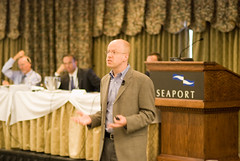
Image by affiliatesummit via Flickr
I am surprised how little the affiliate marketing crowd understands or is aware of the FTC's agenda on deceptive advertising, especially as it relates to business opportunities - buying yourself a job.
People are just not getting it.
Here is Brian Clark, a former attorney, writing at his blog Copyblogger, about testimonials and endorsements for business opportunities.
Brian, who is a smart guy, writes about disclosing your affiliate links:
"Many of my friends in the affiliate marketing industry did not take kindly to my legal observations at the time.
And a lot of people are upset right now, but the FTC will still remove all doubt about the fact that disclosure of compensation and conflicts is required.
Now it becomes clear that even something as small as an Amazon affiliate link to a book or DVD requires disclosure. That represents a big shift in the way things have worked so far."
This is not the big story for affiliate marketers like Brian Clark. Brian, among many others, markets business opportunities, such as Teaching Sells, which I actually joined.
But here is the problem. Testimonials, like this:
I joined Teaching Sells on day one, and after completing the core program I successfully transitioned my flagship SEO Book into an interactive learning environment. The results have been stunning so far." ~ Aaron Wall, SEOBook.com
The "results have been stunning so far" is usually accompanied with a standard disclaimer - "your results may very", or something like that.
This standard disclaimer about earnings potential simply isn't going to work any more. From Hugh Latimer writing about disclaimers.
"At a hearing of the Senate Commerce Committee's consumer protection subcommittee on July 22, 2009, controversy burst forth over the FTC's proposed changes to its advertising guidelines, particularly with respect to consumer endorsements representing a non-typical experience and whether a bare disclaimer of "results not typical" would continue to be permissible.
Current Federal Trade Commission endorsement guidelines provide that a consumer endorsement will be interpreted as representing that the endorser's experience is representative of what consumer's "will generally achieve with the advertised product," for which the advertiser must have adequate substantiation, or "clearly and conspicuously disclose the limited applicability of the endorser's experience to what consumers may generally expect to achieve." § 255.2 (a).
The FTC's pending proposal to significantly curtail, if not eliminate, the use of "results not typical" disclaimers has provoked the controversy.
At the Senate hearing, David Vladeck, Director of the FTC's Bureau of Consumer Protection, testified that § 255.2 (a) of the FTC's current guidelines inadvertently extended an "open-ended invitation" to advertisers to make inflated claims through consumer testimonials that should have been prohibited.
He added that FTC research has shown that the bare "results not typical" disclaimer has not been effective in eliminating consumer deception.
Here is Vladeck's testimony before the Senate about misleading advertising. Read it and as a marketer of business opportunities, you will realize that disclaimers are simply not going to cut it any more.

Full post as published by Misleading Advertising Law on August 20, 2009 (boomark / email).
Vytorin Marketing
alleged false claims in marketing campaign.
Forest Laboratories Potentially Illegal Marketing
Forest Laboratories Potentially Illegal Marketing
Coke
Sued Over Marketing of "VitaminWater"
NOS Communications
settles class action lawsuit regarding deceptive marketing practices
Tyson Foods
accused of deceptively marketing its chicken as "raised without antibiotics"
Marketing Spam
Member Source Media pays $200,000 civil penalty for deceptive online advertising.

#1 Online Legal Resource

On 08-25 at 15:46PM
Acute perpendicular parking #NYPD #NYFD
On 08-18 at 22:18PM
Parallel parking gone bad. Too much gas UES NYC
On 08-18 at 21:41PM
UES NYC
On 08-18 at 21:25PM
Twitter suspends journalist critical of broadcast partner's coverage on dubious grounds @guyadams #nbcfail #twitterfail
On 07-30 at 17:57PM
Model example of 1st Amendment suppression by the People of New York City's Michael Bloomberg #OWS #NYPD
On 07-12 at 21:07PM
AG Holder lackadaisical on Operation in our Sites domain name seizures & RIAA lobbied free speech suppression @dajaz1
On 06-08 at 22:44PM
Why is the Catholic Church going to court over Obama contraception policy? @NewYorker commentary
On 05-31 at 10:08AM
Monks sue Louisiana for right to sell caskets made from forrest destroyed by Katrina
On 05-31 at 07:47AM
Are the abortion ultrasound laws headed for the Supreme Court?
On 05-15 at 21:52PM





Amazon Says "No" to Collecting Sales Tax by Closing Affiliate Accounts
Affiliate marketer violated spyware act
Having a Parent Company Enter Into a Contract On Behalf of an Affiliate
FERC Seeks Industry Input on Uniform Definition of "Affiliate"





 |
|
Contact Us | About Us | Celebrity Law Blog |
Our Partners | Disclaimer
| Law Blog Directory
| Law Jobs
| Law Tweets
| Oil Spill Video
All original material © 1999-2011 by USLaw.com. All other material, including Blog Directory feed content, are © by their respective copyright holders. |