
Home -> Law Blog Directory -> Legal Commentary Blogs -> Agoraphilia
(866) 635-2689 for Personal Injury or (866) 635-9402 for Criminal Defense
Find a Local Lawyer
Divorce (866) 635-6190
Personal Injury (866) 635-2689
Criminal Defense (866) 635-9402

Legal Commentary
: AgoraphiliaZ-Scores in Model of 2010 USN&WR Law School Rankings
By Tom W. Bell and Glen Whitman
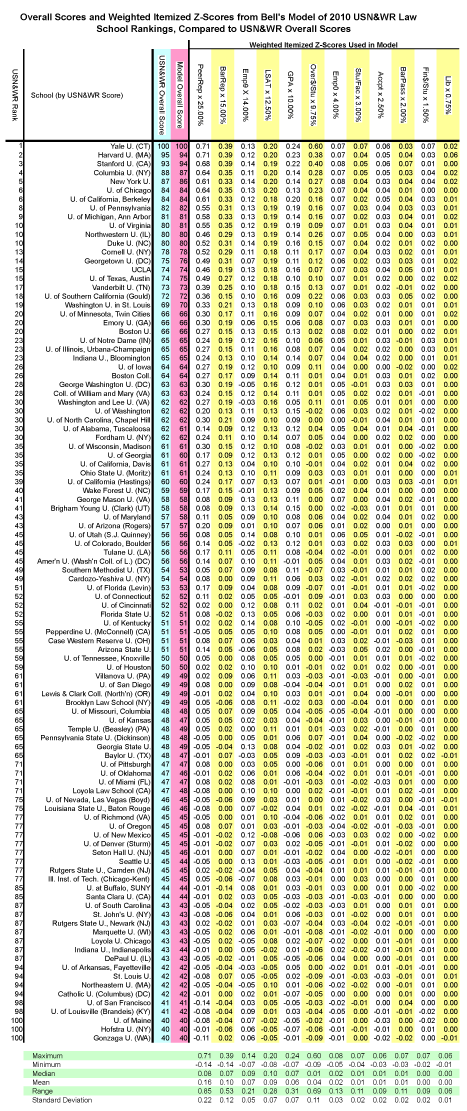
For cross-year comparisons, please see the similar reports I offered in 2005, 2006, 2007, and 2008. This year, in response to a reader's request, I've added various diagnostic measures, such as the mean, median, and standard deviation of each itemized category of data. As I did last year, I again provided weighted z-scores, meaning simply that I've multiplied the z-scores in each category of data by the percentage that category influences a school's overall score. That method of presenting z-scores has the virtue of highlighting which scores matter the most.
Unsurprisingly, you'll generally find the largest numbers in the upper, left-hand corner of the chart. There lie the most heavily-weighted z-scores of the law schools that scored the highest in USN&WR's rankings. Consider, for instance, the .71 weighted z-scores enjoyed by Yale and Harvard under the "PeerRep" category; those numbers nearly swamp the effect of other measures of those schools' performances, and have twice the impact of the peer reputation scores of schools ranked as close as 20th from the top.
This presentation of the data also shows how very little influence many of the things that USN&WR measures have on its rankings. The weighted z-scores for Bar pass rates, for instance, vary between only .07 and -.02, with a whole lot of zeros filling that span. Bar passage rates evidently do not matter much to any school's USN&WR score.
Rankings geeks will doubtless find close study of this table rewarding. I'm especially interested in the surprising impact of the top schools' overhead expenditures/student?a phenomenon that I discussed in some detail last year. Perhaps I'll return to that topic, and raise some new ones, in later posts. In the meantime, I welcome your own observations.
[Crossposted at Agoraphilia, MoneyLaw.]

Full post as published by Agoraphilia on July 23, 2009 (boomark / email).
Radio Transmitters
for Model Aircrafts Recalled
School Racism
School District pays $250,000 in racial harassment settlement.
FedEx
Ground Business Model Wins Class Action in Washington
Student Harassment
Wichita School District pays $45,000 settlement for high school students' harassment lawsuit.
School House Abuse
Selwyn House School agrees to $5 million teacher molestation settlement.
Collins GA
Elementary School Children May Have Been Exposed to Asbestos

#1 Online Legal Resource

On 08-25 at 15:46PM
Acute perpendicular parking #NYPD #NYFD
On 08-18 at 22:18PM
Parallel parking gone bad. Too much gas UES NYC
On 08-18 at 21:41PM
UES NYC
On 08-18 at 21:25PM
Twitter suspends journalist critical of broadcast partner's coverage on dubious grounds @guyadams #nbcfail #twitterfail
On 07-30 at 17:57PM
Model example of 1st Amendment suppression by the People of New York City's Michael Bloomberg #OWS #NYPD
On 07-12 at 21:07PM
AG Holder lackadaisical on Operation in our Sites domain name seizures & RIAA lobbied free speech suppression @dajaz1
On 06-08 at 22:44PM
Why is the Catholic Church going to court over Obama contraception policy? @NewYorker commentary
On 05-31 at 10:08AM
Monks sue Louisiana for right to sell caskets made from forrest destroyed by Katrina
On 05-31 at 07:47AM
Are the abortion ultrasound laws headed for the Supreme Court?
On 05-15 at 21:52PM





A Model of the 2010 USN&WR Law School Rankings
Accuracy of the Model of the 2010 USN&WR Law School Rankings
Z-Scores in Model of 2010 USN&WR Law School Rankings
Z-scores in 2010 U.S. News Rankings
Model of 2009 USN&WR Law School Rankings
Bell: Z-Scores in 2009 U.S. News Law School Rankings
Z-Scores in Model of 2009 USN&WR Law School Rankings





 |
|
Contact Us | About Us | Celebrity Law Blog |
Our Partners | Disclaimer
| Law Blog Directory
| Law Jobs
| Law Tweets
| Oil Spill Video
All original material © 1999-2011 by USLaw.com. All other material, including Blog Directory feed content, are © by their respective copyright holders. |