
Home -> Law Blog Directory -> Podcasts Blogs -> InternetCases.com
(866) 635-2689 for Personal Injury or (866) 635-9402 for Criminal Defense
Find a Local Lawyer
Divorce (866) 635-6190
Personal Injury (866) 635-2689
Criminal Defense (866) 635-9402

Podcasts
: InternetCases.comGovernment spam blocking not a violation of First Amendment right to petition
By Evan Brown
Ferrone v. Onorato, No. 07-4299, 2008 WL 4763257 (3rd Cir. October 31, 2008)
The Third Circuit Court of Appeals has held that a county government did not violate a citizen’s First Amendment right to petition the government for a redress of greivences when the county set its spam filters to block all email from the citizen’s domain. There was no evidence that such blocking was done with intent to deprive the citizen of his Constitutional rights, or with reckless disregard of those rights.
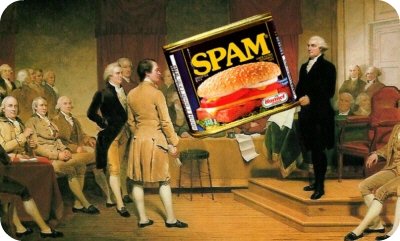
The Founding Fathers managed Spam
The Allegheny County, Pennsylvania office of economic devlopment was getting a lot of email from press@rock-port.com. A county official directed that his IT staff block all future messages sent from that address. Accidentally, however, the filter was set to block all messages from the @rock-port.com domain from being sent to any county account.
Plaintiff Ferrone, who was already in a dispute with the county, tried sending 14 email messages to various county officials over the course of five weeks. Because of the spam filter settings, the messages did not get through. So Ferrone sued, claiming a violation of the First Amendment right to petition the government for a redress of grievences. The county moved for summary judgment and the court granted the motion. Ferrone sought review with the Third Circuit. On appeal, the court affirmed.
The court held that the First Amendment’s prohibition on the “abridgement” of the right to petition the government requires a plaintiff to show an actual intent on the part of the government to diminish this right. The court refused to accept Ferrone’s argument that the act of blocking email messages alone, without an examination of the government’s intent, would rise to the level of a constitutional violation. Rejecting Ferrone’s attempts to “plump” up his “specious claim” by throwing in the First Amendment, the court held that no reasonable factfinder could have found a violation of Constitutional rights.
Full post as published by InternetCases.com on November 06, 2008 (boomark / email).
The Paulson Toxic Mortgage Debt Security Act: The Biggest Government Bailout of All Time
Legislative Proprosal for Treasury Authority to Purchase Mortgage-related Assets
Parody is a Protected Form of Speech
Targets of criticism seek to shut down Internet sites that poke fun
Qui Tam Whistleblower - Government Fraud - Qui Tam Lawsuit
Qui Tam Whistleblower alleging fraud against the government reported by an individual acting as a government whistleblower.
Generic Versions
Barr Pharmaceuticals to pay $5.9 million settlement for blocking the sale of oral contraceptives.
Marketing Spam
Member Source Media pays $200,000 civil penalty for deceptive online advertising.
MySpace Spam
Spammers to pay $230 million settlement in e-mailing lawsuit.
Microsoft Spam
Richter pays $7 million settlement in deceptive email lawsuit.
Environment Law
alleging damages from violation of the law.

#1 Online Legal Resource

On 08-25 at 15:46PM
Acute perpendicular parking #NYPD #NYFD
On 08-18 at 22:18PM
Parallel parking gone bad. Too much gas UES NYC
On 08-18 at 21:41PM
UES NYC
On 08-18 at 21:25PM
Twitter suspends journalist critical of broadcast partner's coverage on dubious grounds @guyadams #nbcfail #twitterfail
On 07-30 at 17:57PM
Model example of 1st Amendment suppression by the People of New York City's Michael Bloomberg #OWS #NYPD
On 07-12 at 21:07PM
AG Holder lackadaisical on Operation in our Sites domain name seizures & RIAA lobbied free speech suppression @dajaz1
On 06-08 at 22:44PM
Why is the Catholic Church going to court over Obama contraception policy? @NewYorker commentary
On 05-31 at 10:08AM
Monks sue Louisiana for right to sell caskets made from forrest destroyed by Katrina
On 05-31 at 07:47AM
Are the abortion ultrasound laws headed for the Supreme Court?
On 05-15 at 21:52PM





"Va. Ban On Spam Is Ruled Unlawful; E-Mail Restriction Called Violation of First Amendment"
Should the First Amendment protect spam





 |
|
Contact Us | About Us | Celebrity Law Blog |
Our Partners | Disclaimer
| Law Blog Directory
| Law Jobs
| Law Tweets
| Oil Spill Video
All original material © 1999-2011 by USLaw.com. All other material, including Blog Directory feed content, are © by their respective copyright holders. |