
Home -> Law Blog Directory -> Legal News Blogs -> Fastcase Legal News
(866) 635-2689 for Personal Injury or (866) 635-9402 for Criminal Defense
Find a Local Lawyer
Divorce (866) 635-6190
Personal Injury (866) 635-2689
Criminal Defense (866) 635-9402

Legal News
: Fastcase Legal NewsFlorida Passes Technology in Elections Act
By rdasgupta
Florida’s election laws are in the news again, and this time for a decidedly technology-forward reason. Florida’s House of Representatives recently passed Technology in Elections Act (HB 869). [St. Petersblog 2.0] [Google Public Policy Blog].
As the Obama campaign showed us, social media and other Internet technologies are becoming an integral part of modern campaign efforts because they empower candidates to get the word out to the masses quickly and cheaply. But as campaign communications move to the web, some are wondering, can state election laws keep up?
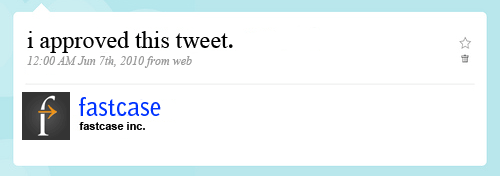
Many states have transparency laws that govern campaign advertising and impose disclosure requirements. These are the laws that you can thank for the “I approve this message”-style disclaimers. Most of these laws were written without technologies like Facebook, Twitter, AdWords in mind, and there has been confusion in some areas about whether and how the laws apply to internet advertising and other forms of communication on the web.
For example, Scott Wagman, a candidate in the 2009 St. Petersburg mayoral election, found himself the subject of a complaint submitted to the Florida Elections Commission as a result of his Google AdWords campaign. The complaint charged that Wagman’s campaign used the names of his opponents as keywords. This meant that if someone searched for the name of Wagman’s opponents, Google would display an ad directing the person to Wagman’s campaign website. [TampaBay.com]
While this AdWords strategy itself raises some interesting issues (it may strike some as brilliant and others as sinister), it wasn’t the keywords that were the problem. According to the complaint, the problem with Wagman’s strategy was that his ads did not contain the political disclaimer required by Section 106.143(1)(a) of the Florida Statutes.
The Florida Election Commission investigated the complaint and ultimately concluded that there was “no probable cause to charge [Wagman]” with the violation. They reasoned that although Wagman’s ads did not contain the required disclaimer, his actions were not willful. After all, Google’s ads only have two lines of text making it virtually impossible to fit the entire required disclaimer into the allotted space.
Florida’s new law attempts to strike a balance between the need for transparency and candidates’ desire to avail themselves of new technologies. For example, pursuant to HB 869, if a “paid link” on the web “is no more than 200 characters” and links “to another Internet website that [includes the disclaimer]” then the paid link need not include the disclaimer itself.
-For the full text of the bill, click here.
-For the Florida House of Representative’s Staff Analysis of the bill, click here.
-For the Florida FEC’s decision regarding the Wagman complaint (via Tampabay.com), click here.
What do you think of Florida’s new law? Are there other states that have enacted something similar?
Send us your comments at comments@fastcase.com or post on our Facebook page.
Full post as published by Fastcase Legal News on June 07, 2010 (boomark / email).
Selection of State Supreme Court Judges
How State Court Judges are Selected
Align Technology, Inc. ALGN Securities Fraud
Align Technology, Inc. ALGN
Align Technology, Inc. 401(k) / ERISA Stock Fraud
Align Technology, Inc. 401(k) / ERISA Stock Fraud
FDA Warns of Potentially Fatal Errors with GDH-PQQ Glucose Monitoring Technology
Glucose Monitoring Technology FDA Warns of Potentially Fatal Errors
International Game Technology
401(k) / ERISA Stock Fraud
Limeno Recalls Rico Queso Duro Blanco in Florida
Limeno Recalls Rico Queso Duro Blanco in Florida
Florida Cement and Concrete Producers Face Price-Fixing Class Action
Florida Cement and Concrete Producers Face Price-Fixing Class Action

#1 Online Legal Resource

On 08-25 at 15:46PM
Acute perpendicular parking #NYPD #NYFD
On 08-18 at 22:18PM
Parallel parking gone bad. Too much gas UES NYC
On 08-18 at 21:41PM
UES NYC
On 08-18 at 21:25PM
Twitter suspends journalist critical of broadcast partner's coverage on dubious grounds @guyadams #nbcfail #twitterfail
On 07-30 at 17:57PM
Model example of 1st Amendment suppression by the People of New York City's Michael Bloomberg #OWS #NYPD
On 07-12 at 21:07PM
AG Holder lackadaisical on Operation in our Sites domain name seizures & RIAA lobbied free speech suppression @dajaz1
On 06-08 at 22:44PM
Why is the Catholic Church going to court over Obama contraception policy? @NewYorker commentary
On 05-31 at 10:08AM
Monks sue Louisiana for right to sell caskets made from forrest destroyed by Katrina
On 05-31 at 07:47AM
Are the abortion ultrasound laws headed for the Supreme Court?
On 05-15 at 21:52PM





And in Other Florida Election Law News...
Florida Passes Tougher Anti-Medicaid Fraud Law
Uncounted: The New Math of American Elections
Senate Passes Regulatory Reform Legislation





 |
|
Contact Us | About Us | Celebrity Law Blog |
Our Partners | Disclaimer
| Law Blog Directory
| Law Jobs
| Law Tweets
| Oil Spill Video
All original material © 1999-2011 by USLaw.com. All other material, including Blog Directory feed content, are © by their respective copyright holders. |