Home -> Law Blog Directory -> Legal Commentary Blogs -> Agoraphilia
(866) 635-2689 for Personal Injury or (866) 635-9402 for Criminal Defense
Find a Local Lawyer
Divorce (866) 635-6190
Personal Injury (866) 635-2689
Criminal Defense (866) 635-9402

Legal Commentary
: AgoraphiliaOriginal Reasons for Non-Originalism
By Tom W. Bell and Glen Whitman
Given the popularity of originalism among self-proclaimed libertarians and conservatives, my view risks raising some hackles among the very people with whom I so often agree in questions about the constitutional limits on government action. So be it. Originalism's foundations have always seemed pretty shaky, to me, even though I usually like the theory's results. It has taken me some years to formulate a different, and I think much more solid, foundation for resolving questions of constitutional meaning. I describe that new approach in a working paper, Graduated Consent Theory, Explained and Applied, Chapman University School of Law, Legal Studies Research Paper Series, Paper No. 09-13 (March 2009) [PDF]. For a snapshot view of the theory, consider this figure from the paper:
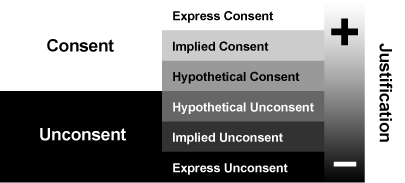
That may look familiar, given that I earlier blogged about The Scale of Consent, a working paper that, in revised form, constitutes one part of this larger paper. Rest assured, though, that this later work has a different, and more ambitious goal. Here is the abstract:
We often speak of consent in binary terms, boiling it down to "yes" or "no." In practice, however, consent varies by degrees. We tend to afford expressly consensual transactions more respect than transactions backed by only implied consent, for instance, which we in turn regard as more meaningful than transactions justified by merely hypothetical consent. A mirror of that ordinal ranking appears in our judgments about unconsensual transactions. This article reviews how a wide range of authorities regard consent, discovering that they treat consent as a matter of degree and a measure of justification. By abstracting from that evidence, we can outline a theory of graduated consent. This article concludes by testing a graduated consent theory against such problems as enforcing standardized agreements, justifying political coercion, and reading a constitution. In those and other applications, a theory of graduated consent can help to advance legal, moral, and economic reasoning.
If I don't sidelined by other, more pressing obligations, I'll post here some excerpts from Graduated Consent Theory. It offers a number of original (but not originalist!) arguments, which I'd like to air for commentary. I plan to publish the paper in a law review and want to make sure the best possible version makes it into print.

Full post as published by Agoraphilia on March 15, 2009 (boomark / email).
DePuy Metal Hip Replacement
alleging defective product recall of ASR hip implant for health reasons.

#1 Online Legal Resource

On 08-25 at 15:46PM
Acute perpendicular parking #NYPD #NYFD
On 08-18 at 22:18PM
Parallel parking gone bad. Too much gas UES NYC
On 08-18 at 21:41PM
UES NYC
On 08-18 at 21:25PM
Twitter suspends journalist critical of broadcast partner's coverage on dubious grounds @guyadams #nbcfail #twitterfail
On 07-30 at 17:57PM
Model example of 1st Amendment suppression by the People of New York City's Michael Bloomberg #OWS #NYPD
On 07-12 at 21:07PM
AG Holder lackadaisical on Operation in our Sites domain name seizures & RIAA lobbied free speech suppression @dajaz1
On 06-08 at 22:44PM
Why is the Catholic Church going to court over Obama contraception policy? @NewYorker commentary
On 05-31 at 10:08AM
Monks sue Louisiana for right to sell caskets made from forrest destroyed by Katrina
On 05-31 at 07:47AM
Are the abortion ultrasound laws headed for the Supreme Court?
On 05-15 at 21:52PM





Balkin on Framework Originalism and Skyscraper Originalism
Primus on Originalism (and a comment on the interpretation-construction distinction)
Wuerth on Originalism & Foreign Affairs





 |
|
Contact Us | About Us | Celebrity Law Blog |
Our Partners | Disclaimer
| Law Blog Directory
| Law Jobs
| Law Tweets
| Oil Spill Video
All original material © 1999-2011 by USLaw.com. All other material, including Blog Directory feed content, are © by their respective copyright holders. |