
Home -> Law Blog Directory -> Bailout Blogs -> Calculated Risk
(866) 635-2689 for Personal Injury or (866) 635-9402 for Criminal Defense
Find a Local Lawyer
Divorce (866) 635-6190
Personal Injury (866) 635-2689
Criminal Defense (866) 635-9402

Bailout
: Calculated RiskHousehold Debt as a Percent of GDP
By Anonymous
"There have always been Wall Street economists wanting to cheerlead the recovery, and quick to jump on any piece of news showing a great boom is around the corner," said Kenneth Rogoff, a Harvard economist. "The data so far are more consistent with a very moderate recovery."There are a number of reasons that would be the case. American households are trying to reduce debt to stabilize finances. But they are doing so slowly, with total household debt at 94 percent of gross domestic product in the fourth quarter down just slightly from 96 percent when the recession began in late 2007.
...
"When you have a recession that's amplified by a deep financial crisis, the recovery is slower and more painful, much akin to recovering from a heart attack," said Rogoff ... "It just takes time. If you look at a typical recovery, we would be growing at 7 or 8 percent by now given the depth of our fall."
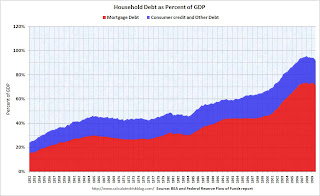 Click on graph for larger image.
This graph, based on the Federal Reserve Flow of Funds data, shows household debt as a percent of GDP through Q4 2009 (note: I removed a few non-profit categories).
Note that the household debt problem is mostly a mortgage debt problem. Mortgage debt as a percent of GDP started really picking up in 2001 and 2002 and continued to increase sharply through 2006.
There was also a sharp increase in mortgage debt in the late '80s. That was partially associated with Tax Reform Act of 1986 that only allowed mortgage debt to be tax deductible, and excluded interest on all personal loans including credit card debt. There was also a smaller housing bubble in the late '80s that was associated with the increase in mortgage debt.
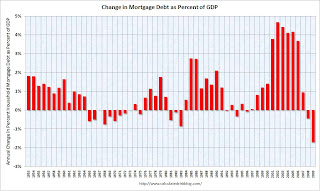 The second graph shows the annual change in the percent of household mortgage debt.
There was some increase in the late '90s associated with the booming economy and stock bubble wealth effect. But the real boom in mortgage debt started in the 2nd half of 2001 - and continued through 2006. This rapid increase in mortgage debt should have been a red flag for regulators.
Finally, on Rogoff's comment about "Wall Street economists wanting to cheerlead the recovery", there is an old saying on Wall Street for analysts: Bearish equals unemployed. Of course they are cheerleading!

Full post as published by Calculated Risk on April 14, 2010 (boomark / email).
The Mortgage Forgiveness Debt Relief Act
Phantom Income Relief on Debt Cancellation
Collection Agencies and Creditors
How to deal and stop the harassment
Bankruptcy Law
A complete prime (pre-2005)
The Paulson Toxic Mortgage Debt Security Act: The Biggest Government Bailout of All Time
Legislative Proprosal for Treasury Authority to Purchase Mortgage-related Assets
Emergency Economic Stabilization Act of 2008
Bailout Bill HR124
Truth In Lending Act
Consumer Loans and Consumer Credit Protection Act
Creditor Debt
Trophy Resources agrees to $600,000 debt settlement.
Bankruptcy
helping to get you out of debt.
Mel Harris and Associates Debt Collection
Face Class Action for Alleged "Sewer Service" Practices
AireSurf Networks Holdings Inc.
$23,147 debt settlement made by issuance of 115,735 common shares.
Too Much Debt
Titan Oil and Gas to pay $179,477 settlement in financial lawsuit.

#1 Online Legal Resource

On 08-25 at 15:46PM
Acute perpendicular parking #NYPD #NYFD
On 08-18 at 22:18PM
Parallel parking gone bad. Too much gas UES NYC
On 08-18 at 21:41PM
UES NYC
On 08-18 at 21:25PM
Twitter suspends journalist critical of broadcast partner's coverage on dubious grounds @guyadams #nbcfail #twitterfail
On 07-30 at 17:57PM
Model example of 1st Amendment suppression by the People of New York City's Michael Bloomberg #OWS #NYPD
On 07-12 at 21:07PM
AG Holder lackadaisical on Operation in our Sites domain name seizures & RIAA lobbied free speech suppression @dajaz1
On 06-08 at 22:44PM
Why is the Catholic Church going to court over Obama contraception policy? @NewYorker commentary
On 05-31 at 10:08AM
Monks sue Louisiana for right to sell caskets made from forrest destroyed by Katrina
On 05-31 at 07:47AM
Are the abortion ultrasound laws headed for the Supreme Court?
On 05-15 at 21:52PM





Mortgage Liabilities Shrink as Borrowers Pay Down Debt
U.S. Now on the Receiving End of Economic Advice
Household Income and Debt Trends Since 1980: Quick Picks
Save Money on Your Credit Card Bills With Your Phone
When Can An Alabama Consumer Sue A Debt Collector - Part One





 |
|
Contact Us | About Us | Celebrity Law Blog |
Our Partners | Disclaimer
| Law Blog Directory
| Law Jobs
| Law Tweets
| Oil Spill Video
All original material © 1999-2011 by USLaw.com. All other material, including Blog Directory feed content, are © by their respective copyright holders. |