Home -> Law Blog Directory -> Intellectual Property Law Blogs -> IPKat
(866) 635-2689 for Personal Injury or (866) 635-9402 for Criminal Defense
Find a Local Lawyer
Divorce (866) 635-6190
Personal Injury (866) 635-2689
Criminal Defense (866) 635-9402

Intellectual Property Law
: IPKatThe requirement for an invention
By Johanna Gibson, David Pearce, Jeremy Phillips and Ilanah Simon.
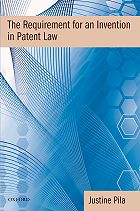 The IPKat has been taking a look at a new title on an old subject --The Requirement for an Invention in Patent Law, by respected Oxford academic Justine Pila. Justine Pila, an Official Fellow of St Catherine's College, Oxford, is also University Lecturer in Intellectual Property and a great enthusiast for historical, doctrinal and theoretical dimensions to the subject, as this new title shows.
"A central theme of the book is that the requirement for an invention, properly construed, sets the boundaries of the patent system in two ways. The first is by defining the categories of subject matter capable of supporting a patent, and the second is by restricting the protection conferred by a patent to individual subject matter conceived qua invention [the Kat wonders whether a good case can be made for trying this the other way round, arguing that it's the acceptance of certain categories of subject matter that shapes the requirement for an invention ...]. In serving these functions, the requirement for an invention helps to fulfil the public benefit objectives of the patent system by mediating the balance struck by patents between individual patentees and the public.
This book offers an analysis of legal conceptions of the invention in UK patent law and their development from before the first patent legislation of 1623 through the patent system's recent phase of Europeanisation [This is a remarkable conceptual and functional evolution. If we didn't know what the system looks like today, it would be impossible to predict it from its earliest sources]. It includes a detailed study of the contemporary (EPC) requirement for an invention and its construction by the European Patent Office, and an analysis of the legal and policy issues which that construction raises. It also places the UK and EPC law in its interpretive context, including its international statutory context, and offers a detailed account of international law-making in the field of patents" [The Kat thinks international patent law-making would make a great multi-party board game. The only problem is working out who the winners are ...].This book unashamedly appeals to academics and patent law makers -- but that's no excuse for not reading. The practitioner will find a surprising amount of case law, discussed and deployed effectively in its context. And while the undergraduate IP student may find it hard to squeeze a thorough read of it into the crowded schedule of coursework and revision commitments, the IP research candidate will be able to stand on the author's shoulders, as it were, and view the horizon of PhD topics from an altogether higher standpoint.

Full post as published by IPKat on June 15, 2010 (boomark / email).
Language Requirements for Citizenship
Naturalization without an English language test
Davison and Associates
Invention Promoters to Pay $10 Million in FTC Settlement

#1 Online Legal Resource

On 08-25 at 15:46PM
Acute perpendicular parking #NYPD #NYFD
On 08-18 at 22:18PM
Parallel parking gone bad. Too much gas UES NYC
On 08-18 at 21:41PM
UES NYC
On 08-18 at 21:25PM
Twitter suspends journalist critical of broadcast partner's coverage on dubious grounds @guyadams #nbcfail #twitterfail
On 07-30 at 17:57PM
Model example of 1st Amendment suppression by the People of New York City's Michael Bloomberg #OWS #NYPD
On 07-12 at 21:07PM
AG Holder lackadaisical on Operation in our Sites domain name seizures & RIAA lobbied free speech suppression @dajaz1
On 06-08 at 22:44PM
Why is the Catholic Church going to court over Obama contraception policy? @NewYorker commentary
On 05-31 at 10:08AM
Monks sue Louisiana for right to sell caskets made from forrest destroyed by Katrina
On 05-31 at 07:47AM
Are the abortion ultrasound laws headed for the Supreme Court?
On 05-15 at 21:52PM





Trade Secrets and the "Best Mode" Requirement -- No. 21
Don't Get A Patent Plainly Ridiculous!
The Requirement that the Written Description be Concise
Prohibited Words in a Patent – “Invention”
Trade Secrets and the Best Mode Requirement: Patent/Trade Secret Complimentariness No. 12





 |
|
Contact Us | About Us | Celebrity Law Blog |
Our Partners | Disclaimer
| Law Blog Directory
| Law Jobs
| Law Tweets
| Oil Spill Video
All original material © 1999-2011 by USLaw.com. All other material, including Blog Directory feed content, are © by their respective copyright holders. |