
Home -> Law Blog Directory -> Legal Commentary Blogs -> Agoraphilia
(866) 635-2689 for Personal Injury or (866) 635-9402 for Criminal Defense
Find a Local Lawyer
Divorce (866) 635-6190
Personal Injury (866) 635-2689
Criminal Defense (866) 635-9402

Legal Commentary
: AgoraphiliaPolice May be Monitored for Quality Control Purposes
By Tom W. Bell and Glen Whitman

Radley Balko recently reported on the latest attempt to use privacy laws to punish citizens for recording police misconduct. In this case, Anthony Graber was arrested for posting on YouTube a video he'd captured on an un-uniformed Maryland state trooper, driving an unmarked car, pulling over and rushing at Graber with a drawn handgun. Soon after Graber posted the video, he was charged for violating the Maryland Wiretapping and Electronic Surveillance Act, Md. Code Ann., Cts. & Jud. Proc. § 10-401 et seq. (2010), which basically outlaws secretly recording a private conversation.
Maryland's police must be feeling a bit testy, these days, about getting recorded on-the-job by uppity citizens. Earlier this spring, an inconvenient video of the beating of Jack McKenna put the lie to the claims of Maryland police that McKenna had provoked the incident by attacking the officers and their horses. State and federal officials have since launched "excessive force" inquiries.
Did that video violate the privacy of the three officers, clad in riot gear and swinging batons, who surrounded and beat the unarmed McKenna? No. Neither did the video that Graber shot of the Maryland trooper strutting towards him with a drawn handgun. Courts have already explained that wrongs under the Maryland Wiretapping and Electronic Surveillance Act require a showing that someone's reasonable expectation of privacy has suffered violation (see Fearnow v. C & P Tel. Co., 104 Md. App. 1, 655 A.2d 1 (1995), rev'd on other grounds, 342 Md. 363, 676 A.2d 65 (1996)), and no officer can have a reasonable expectation of privacy while on a public street, performing public duties.
The Maryland ACLU has stepped forward to help defend Graber, and with any luck will soon educate local prosecutors about the proper scope of the Maryland Wiretapping and Electronic Surveillance Act. In the meantime, and in other jurisdictions where police threaten to deploy privacy laws against whistle-blowers, we citizens would do well to remind public servants that we can and will record their on-the-job performance. I've worked up a couple of notices to help.
This bumper sticker should help to put police on notice that you may record them during traffic stops, thus negating any claim to a reasonable expectation of privacy:
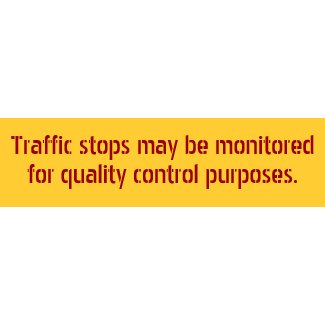
To make doubly sure that you give adequate notice to an officer who subjects you to a traffic stop, you might also want to carry this handy magnetic sign:
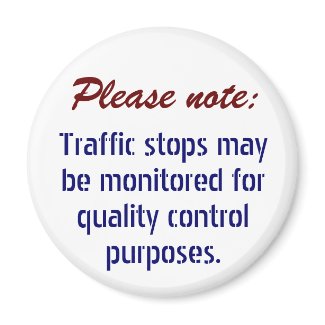
Click on either image to buy a copy for yourself or a friend. All proceeds will go to aid the defense of Anthony Graber. Perhaps his case would have turned out differently if he had had that bumper sticker on his helmet, or that magnetic sign on his gas tank. (I thank Prof. Orin Kerr for inspiring the wording of these notices, though he of course bears no blame for my legal hijinks.)
In the long run, as Prof. Glenn Reynolds has observed, we in the surveillance citizenry have an edge over those trying to create a surveillance state. We have more eyes, more cameras, and a more sympathetic message. There remain, however, several legal wrinkles to iron out before we can safely say we've turned the tables. I'll try to say more about those, and offer an all-purpose notice designed to cover a wide variety of citizen surveillance practices, in a subsequent post.
[Crossposted at Agoraphilia and The Technology Liberation Front.]

Full post as published by Agoraphilia on May 30, 2010 (boomark / email).
Ortho Evra Patch Risk
Ortho Evra Side Effects
Have you or a loved one suffered from Ortho Evra side effects?
Ortho Evra Side Effects
Clearwire Service
alleging poor quality and unfairly charging early termination fees.
Ford Recalls
alleging cruise control switches are defective.
Polaris All-Terrain Vehicles
Defective Electronic Control Modules
Mongoose Youth ATVs
Recalled By KYMCO Due to Loss of Speed Control
Liberty National Life Insurance Co.
allegedly discriminated against Haitians by offering low quality policies and canceling without reason.
Mazda Motor Corp.
alleging defective speed control switches can lead to fires.

#1 Online Legal Resource

On 08-25 at 15:46PM
Acute perpendicular parking #NYPD #NYFD
On 08-18 at 22:18PM
Parallel parking gone bad. Too much gas UES NYC
On 08-18 at 21:41PM
UES NYC
On 08-18 at 21:25PM
Twitter suspends journalist critical of broadcast partner's coverage on dubious grounds @guyadams #nbcfail #twitterfail
On 07-30 at 17:57PM
Model example of 1st Amendment suppression by the People of New York City's Michael Bloomberg #OWS #NYPD
On 07-12 at 21:07PM
AG Holder lackadaisical on Operation in our Sites domain name seizures & RIAA lobbied free speech suppression @dajaz1
On 06-08 at 22:44PM
Why is the Catholic Church going to court over Obama contraception policy? @NewYorker commentary
On 05-31 at 10:08AM
Monks sue Louisiana for right to sell caskets made from forrest destroyed by Katrina
On 05-31 at 07:47AM
Are the abortion ultrasound laws headed for the Supreme Court?
On 05-15 at 21:52PM





China Quality Control (QC). Who To Hire
Pssst. China Has Quality Control Laws. Et Tu Hugo
Crowdsourcing SCOTUS for Quality Control
How To Handle Bad Product From Your China Supplier.
Dallas Texas Police Department’s “Bait Car” Program Kills Innocent Senior Citizen





 |
|
Contact Us | About Us | Celebrity Law Blog |
Our Partners | Disclaimer
| Law Blog Directory
| Law Jobs
| Law Tweets
| Oil Spill Video
All original material © 1999-2011 by USLaw.com. All other material, including Blog Directory feed content, are © by their respective copyright holders. |