
Home -> Law Blog Directory -> Legal Commentary Blogs -> TalkLeft
(866) 635-2689 for Personal Injury or (866) 635-9402 for Criminal Defense
Find a Local Lawyer
Divorce (866) 635-6190
Personal Injury (866) 635-2689
Criminal Defense (866) 635-9402

Legal Commentary
: TalkLeftSupreme Court Limits Miranda Warnings and Holds Incarceration May Not Be Custody
By Jeralyn

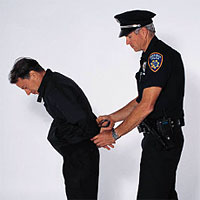
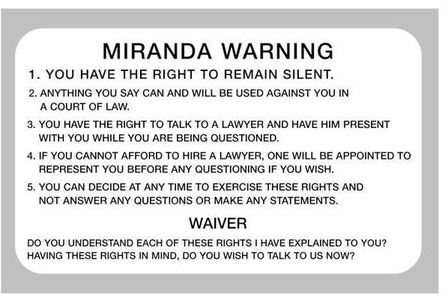
Miranda warnings are required to be given when a suspect is in a custodial setting. If the suspect invokes his right to refuse to answer questions without a lawyer, no questioning can take place. If he starts to answer questions and then asks for a lawyer, questioning must cease. If these rules aren't followed, Edwards v. Arizona allows a subsequent confession to be suppressed. Under Edwards, any subsequent waiver of Miranda rights is presumed involuntary unless the suspect, rather than the police, reinitiated questioning. The
The Supreme Court today ruled in Maryland v. Schatzer that if the suspect asks for a lawyer and is released without questioning taking place, that request is only valid for two weeks. Scotus Blog reports here and has the opinion here. The opinion is written by Justice Scalia. No one dissented, including Sotomayor, but Justices Stevens and Thomas filed their own opinions concurring in part and concurring in the judgment. [More....]
In other words, after two weeks, police can bring the suspect back into custody as if he never invoked his right to a lawyer, read him his Miranda rights again, and hope this time he answers without a lawyer.
This is an invitation to "catch and release." At some point, I would think, an individual is going to get sick of the hassle of being brought down to the station house to answer questions, particularly if they are on the job and get pulled out of work every few weeks, and just answer the questions to get it over with.
The case involved a man who was already serving a sentence. It also involved a delay of two and one half years between questioning. Yet, today the Supreme Court says it wants to give law enforcement guidance, so it sets a 14 days as the maximum period Miranda warnings are valid. To top it off, it holds that incarceration is not necessarily "in custody" for interrogation and Miranda purposes, coming up with a distinction called "interrogative custody." It reasons that since for an inmate serving a prison sentence, the prison is his home, and he can go places like the prison library, he's not in a custodial setting just because he can't leave and his home is a prison.
Full post as published by TalkLeft on February 24, 2010 (boomark / email).
Selection of State Supreme Court Judges
How State Court Judges are Selected
California Supreme Court Proposition 8 Decision
Court Rejects Challenges to Proposition 8, but Finds Marriages Valid
Is Barack Obama a Natural Born Citizen?
Wrotnowski v. Bysiewicz (Supreme Court): Does Obama meet the constitutional requirements to be President
Unwed Fathers' Rights in Adoption
Landmark Cases in Adoption Law Shape Law with respect to Unwed Fathers
Child Support Orders
How to modify terms
Law Enforcement and Criminal Justice Career Choices
Descriptions of law enforcement occupations
Acetaminophen
FDA Wants New Safety Warnings
Family Law
involving divorce, child custody, spousal support, common law, adoption and same sex marriage.
CellCept
Roche Issues Changes to Warnings and Adverse Events
Darvon
Other Propoxyphene-Containing Meds to Require Stronger Warnings
Immigrant Sedation
US Government awards two detainees $55,000 settlement after drugging them while in custody.
Sheriff Interfered With Custody Battle
Greene County to pay $85,000 settlement in trespassing lawsuit.

#1 Online Legal Resource

On 08-25 at 15:46PM
Acute perpendicular parking #NYPD #NYFD
On 08-18 at 22:18PM
Parallel parking gone bad. Too much gas UES NYC
On 08-18 at 21:41PM
UES NYC
On 08-18 at 21:25PM
Twitter suspends journalist critical of broadcast partner's coverage on dubious grounds @guyadams #nbcfail #twitterfail
On 07-30 at 17:57PM
Model example of 1st Amendment suppression by the People of New York City's Michael Bloomberg #OWS #NYPD
On 07-12 at 21:07PM
AG Holder lackadaisical on Operation in our Sites domain name seizures & RIAA lobbied free speech suppression @dajaz1
On 06-08 at 22:44PM
Why is the Catholic Church going to court over Obama contraception policy? @NewYorker commentary
On 05-31 at 10:08AM
Monks sue Louisiana for right to sell caskets made from forrest destroyed by Katrina
On 05-31 at 07:47AM
Are the abortion ultrasound laws headed for the Supreme Court?
On 05-15 at 21:52PM





Here We Go Again: U.S. Supreme Court to tackle clarity of Miranda warnings again
When Are Miranda Warnings Required
Supreme Court Engages in 'Talmudic Parsing' of Miranda Rights





 |
|
Contact Us | About Us | Celebrity Law Blog |
Our Partners | Disclaimer
| Law Blog Directory
| Law Jobs
| Law Tweets
| Oil Spill Video
All original material © 1999-2011 by USLaw.com. All other material, including Blog Directory feed content, are © by their respective copyright holders. |