Home -> Law Blog Directory -> Academic Blogs -> Essentially Contested America
(866) 635-2689 for Personal Injury or (866) 635-9402 for Criminal Defense
Find a Local Lawyer
Divorce (866) 635-6190
Personal Injury (866) 635-2689
Criminal Defense (866) 635-9402

Academic
: Essentially Contested AmericaTruth, Justification, & American Law
By Robert Justin Lipkin

The concept of truth is the most obvious and (yes simultaneously) the most arcane concept in legal reasoning. In one sense, no lawyer or judge can do without the idea of legal truth. Indeed, the goal of a trial is to fairly arrive at the truth. But it's nonetheless difficult to appreciate just what the concept means and what role it plays in legal ratiocination. Is it true that the defendant committed the crime? How does that sentence differ from "Did the defendant commit the crime?"
This puzzle is not restricted to legal reasoning. Consider the following: Is it true that it is now raining? Just go look. If it is raining, then the sentence "It is raining" is However
we understand truth generally or in legal reasoning, the notion of
justification can't be too far behind. Indeed, it's difficult to
understand either concept without making essential reference to the
other. A legal proposition is justification whenever it is true. And
I can justify a legal proposition only if I can provide evidence of its
truth. Indeed, justification seems more dependent on truth than truth
is dependent on justification. The conventional wisdom is that
the goal of a trial is truth--what happened, who did it, under what
circumstances--while justification--consensus--whether unanimous or
not--is all we ever really achieve. In appellate courts we seek the
true meaning of the law and whether the lower court committed some
mistake concerning the law's meaning or application. But all we get is
a consensus of the appellate panel, whether en banc or ordinary. Consequently, in the American legal system, justification seems to trump truth. In the brief exchange between Rorty and the French analytic philosopher Pascal Engel, in What's the Use of Truth? [WUT]
the tension between retaining justification while abandoning truth
becomes prominent. Engel and Rorty, have a lively debate regarding
these and other issues involving truth, justification, and the
attractiveness of analytic philosophy. For those interested in these
conceptual, epistemic, and historical issues, this book is highly
recommended.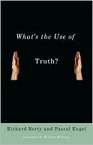 true. Nothing can be simpler or more routine. But what does the predicate "is true" add to
the sentence "It is raining"? Does the predicate entail that the
sentence or the truth of the sentence reflects, pictures, or
corresponds to the way things are? If so, just how should we understand
this idea of a sentence corresponding to reality? Does the sentence
contain a snapshot of rain falling on one's head? What about the
proposition "2+2=4"? Does this sentence, because it is true, reflect
some fact in the world? If so, it seems to be a rather mysterious sort
of fact. "2" and "4" are curious enough facts in the world. But what
about the relations "+" and "="? The sentence "American
constitutionalism creates a separation of federal powers." is true.
But does that mean that the sentence itself "corresponds" to the White
House, the Capitol, and the Supreme Court building or some relation
between the three? Can sentences reflect relations?
No one has done more to disparage truth than the late Richard
Rorty, a recovering analytic philosopher whose more healthy persona
embraced pragmatism. Rorty insists that truth as a reflector of
reality doesn't exist. All we ever have are sentences that achieve
some sort of consensus. Rorty often refers to this consensus as justification. For Rorty, "[w]e do not have any way to establish the truth of a belief or the rightness of an action except by reference to the justification we offer for thinking what we think or doing what we do. The philosophical distinction between justification and truth seems not to have any practical consequences." See WUT,
below at 44-45. Is that right? Isn't truth necessary, conceptually
necessary, to make sense of justification. Without the normative
notion of correctness, of truth, justifications become empty. Or put
differently, making sense of justification requires the notion that
whatever is justified would be true absent the ordinary conditions
limiting justification such as complete knowledge, flawless reasoning,
and so forth.
In Rorty's attempt to cut
truth from its moorings in our conceptual scheme, the idea of
justification seems to go with it. Yet, if Rorty prefers justification
to truth he most certainly is throwing the baby (justification) out
with the bath water (truth). In other words, we can't make sense of
justification without appealing to some conception of truth. Perhaps,
there is some way to throw both notions out yet retain a manner of
speaking that it not egregiously relativist or subjective. But no one
has yet done so convincingly.
Full post as published by Essentially Contested America on May 28, 2008 (boomark / email).
Chevy Chase Bank
lawsuit claims the bank is in violation of the Truth in Lending Act
American Airlines Settles Price Fixing Class Action
American Airlines Settles Price Fixing Class Action
American Corrective Counseling Services to Pay $2.55 Million In Pennsylvania Class Action
American Corrective Counseling Services to Pay $2.55 Million In Pennsylvania Class Action
First American Corporation
NYSE: FAF
American International Group, Inc.
AIG
First American Corporation
401k / ERISA Stock Fraud

#1 Online Legal Resource

On 08-25 at 15:46PM
Acute perpendicular parking #NYPD #NYFD
On 08-18 at 22:18PM
Parallel parking gone bad. Too much gas UES NYC
On 08-18 at 21:41PM
UES NYC
On 08-18 at 21:25PM
Twitter suspends journalist critical of broadcast partner's coverage on dubious grounds @guyadams #nbcfail #twitterfail
On 07-30 at 17:57PM
Model example of 1st Amendment suppression by the People of New York City's Michael Bloomberg #OWS #NYPD
On 07-12 at 21:07PM
AG Holder lackadaisical on Operation in our Sites domain name seizures & RIAA lobbied free speech suppression @dajaz1
On 06-08 at 22:44PM
Why is the Catholic Church going to court over Obama contraception policy? @NewYorker commentary
On 05-31 at 10:08AM
Monks sue Louisiana for right to sell caskets made from forrest destroyed by Katrina
On 05-31 at 07:47AM
Are the abortion ultrasound laws headed for the Supreme Court?
On 05-15 at 21:52PM





Kang on Truth & Freedom of Religious Expression
Westen on Fletcher on Subjective Justification
Appeal to 4th Circuit of "Real Truth Against Obama" Case
This Wisconsin church speaks the truth!





 |
|
Contact Us | About Us | Celebrity Law Blog |
Our Partners | Disclaimer
| Law Blog Directory
| Law Jobs
| Law Tweets
| Oil Spill Video
All original material © 1999-2011 by USLaw.com. All other material, including Blog Directory feed content, are © by their respective copyright holders. |