Home -> Law Blog Directory -> Politics Blogs -> Open Congress
(866) 635-2689 for Personal Injury or (866) 635-9402 for Criminal Defense
Find a Local Lawyer
Divorce (866) 635-6190
Personal Injury (866) 635-2689
Criminal Defense (866) 635-9402

Politics
: Open CongressBachmann Falsely Claims Billions Were 'Hidden' in Health Care Reform
By Sunlight Foundation & Participatory Politics Foundation

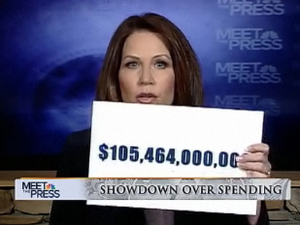
Almost a year after the Patient Protection and Affordable Care Act was signed into law, the misinformation campaign about what’s in it just won’t stop. The most recent example is from Rep. Michelle Bachmann [R, MN-6], who claims that the Democrats snuck more than a hundred billion dollars in the bill and passed it secretly without public review. But Bachmann’s either lying or she has no idea what she’s talking about because her claims are just flat-out false.
Her comments came during an appearence on Meet the Press. Here’s what she said:
There was a Congressional Research Service report that just was issued in February, and we discovered that secretly, unbeknownst to members of Congress, over $105 billion was hidden in the Obamacare legislation to fund the implementation of Obamacare. This is something that wasn’t known. This money was broken up, hidden in various parts of the bills.
The CRS report she’s referring to runs down all of the mandated appropriations and fund transfers in the law. This is money that was provided by the bill so the government could begin implementing parts of it right away — stuff like a temporary insurance program for people with pre-existing conditions and setting up the state-based exchanges that will make it easier for consumer to compare different insurance options.
Far from being hidden, all you have to do to see these funds in the bill is run a find-text page search for on the legislative text for terms like “appropriated” or “transferred” and you’ll see it. For example, here’s what the first item listed in the CRS report, appropriations for states to improve insurance consumer information, looks like in the bill:
(1) INITIAL FUNDING. There is hereby appropriated to the Secretary, out of any funds in the Treasury not otherwise appropriated, $30,000,000 for the first fiscal year for which this section applies to carry out this section. Such amount shall remain available without fiscal year limitation.
(2) AUTHORIZATION FOR SUBSEQUENT YEARS. There is authorized to be appropriated to the Secretary for each fiscal year following the fiscal year described in paragraph (1), such sums as may be necessary to carry out this section.
You can read it in context here.
As you can see, there’s nothing hidden about this. It doesn’t take a lawyer to understand that this language is appropriating funds. Any lay person could tell you what this provision does, let alone any member of Congress whose job is to know how to read this stuff. More than 2 million people managed to use OpenCongress to read the health care bill before it was passed by Congress. Besides the extraordinary length of the bill, there was nothing preventing Bachmann or anyone else from looking at what kind of money was going to be made available by the bill. Every version of the bill was publicly available online for at least 72 hours before votes (which, btw, was one of the first uses of the 72-hour rule that the Republicans have now made an official House rule) and the 85%-similar original bill, H.R.3200, was online for more than 6 months before any votes took place.
People reviewing this legislation have known about these funds all along. For example, when the Congressional Budget Office prepared its report showing that the bill would reduce the deficit by $131 billion over a ten year period, the mandated appropriations and fund transfers were factored in.
Full post as published by Open Congress on March 10, 2011 (boomark / email).
Medicare
Guide to government health insurance for the elderly
Paxil Lawsuit
Paxil Claims, Lawsuits, and Injuries
Military Veterans Benefits
How to obtain full range of benefits for veterans and dependnets
The Dannon Company, Inc.
allegedly falsely claimed Activia and DanActive probiotic yogurt products had scientifically proven health benefits.
Lawsuit Filed Against Legacy Health Care Facilities for Nursing Home Abuse
Legacy Health Care Facilities Face Class Action Over Allegations of Abuse
Coventry Health Care, Inc. 401(k) / ERISA Stock Fraud
Coventry Health Care, Inc. 401(k) / ERISA Stock Fraud
Skilled Health Care Faces $670 Million in Damages over Nursing Home Violations
Skilled Health Care Faces $670 Million in Damages over Nursing Home Violations
Sun Mar Health Care Settles Class Action for $2 Million
Pittsburgh Health Care Facilities
Facing Wages Class Actions

#1 Online Legal Resource

On 08-25 at 15:46PM
Acute perpendicular parking #NYPD #NYFD
On 08-18 at 22:18PM
Parallel parking gone bad. Too much gas UES NYC
On 08-18 at 21:41PM
UES NYC
On 08-18 at 21:25PM
Twitter suspends journalist critical of broadcast partner's coverage on dubious grounds @guyadams #nbcfail #twitterfail
On 07-30 at 17:57PM
Model example of 1st Amendment suppression by the People of New York City's Michael Bloomberg #OWS #NYPD
On 07-12 at 21:07PM
AG Holder lackadaisical on Operation in our Sites domain name seizures & RIAA lobbied free speech suppression @dajaz1
On 06-08 at 22:44PM
Why is the Catholic Church going to court over Obama contraception policy? @NewYorker commentary
On 05-31 at 10:08AM
Monks sue Louisiana for right to sell caskets made from forrest destroyed by Katrina
On 05-31 at 07:47AM
Are the abortion ultrasound laws headed for the Supreme Court?
On 05-15 at 21:52PM





THE WHOLE FOODS ALTERNATIVE to ObamaCare. While we clearly need health-care reform, the last thing
CNN: ObamaCare's Massive, Hidden Tax Change
More on the Constitutionality of Health Care Reform
Tort Reform No Cure For What Ails Our Health Care System
The Need For Health Care Reform
Judge dismisses claims in Ann Arbor law firms challenge to health care reform





 |
|
Contact Us | About Us | Celebrity Law Blog |
Our Partners | Disclaimer
| Law Blog Directory
| Law Jobs
| Law Tweets
| Oil Spill Video
All original material © 1999-2011 by USLaw.com. All other material, including Blog Directory feed content, are © by their respective copyright holders. |